Industry Trends
2026-07-30
Content
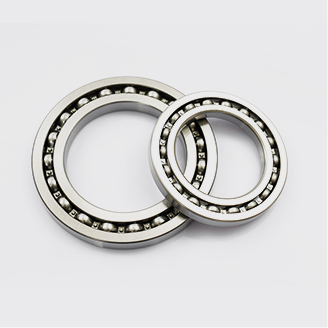
A deep groove ball bearing is one of the simplest rolling components in a machine, and one of the hardest to replace with anything better at high speed. Its deep raceway grooves keep the steel balls in stable contact with both rings, cutting friction, holding accuracy, and letting a shaft spin fast without shaking itself apart.
That combination of low friction, compact size, and reliable load handling is why this bearing type still shows up in motors, machine tools, pumps, and automation systems decades after its design was standardized. Here is what makes it work, where it earns its place, and how to pick the right one.
The inner ring rotates with the shaft while steel balls roll — not slide — between the inner and outer raceways. Rolling contact is inherently lower friction than sliding contact, and that single design choice cascades into four practical advantages.
Rolling contact reduces resistance compared with sliding or plain bearings.
Stable raceway geometry supports sustained high-speed rotation.
Precision machining limits vibration and operating noise.
Hardened steel and proper lubrication resist wear over time.
The design also handles moderate axial loads in both directions on top of its radial capacity, which is part of why it works in so many different machine layouts without a redesign.
Deep groove ball bearings turn up anywhere a shaft needs to spin smoothly and quickly:
Bearing selection usually comes down to a trade-off between speed, load, and axial capacity.
| Feature | Deep Groove Ball Bearing | Roller Bearing |
| Speed Capability | Higher | Moderate |
| Load Capacity | Moderate | Higher |
| Friction | Lower | Higher |
| Main Use | High-speed equipment | Heavy-load machinery |
| Feature | Deep Groove Ball Bearing | Angular Contact Bearing |
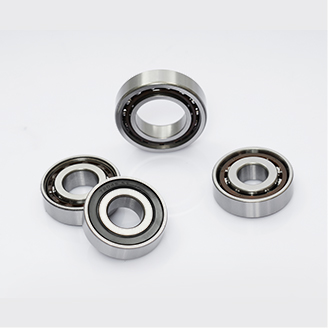
| Load Direction | Radial + moderate axial | Higher axial capacity |
| Speed | High | High |
| Applications | General machinery | Precision spindle systems |
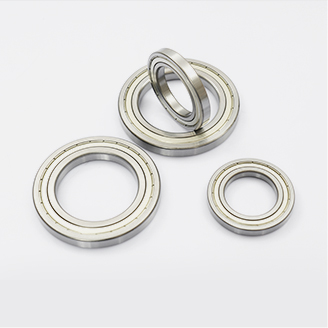
Load and speed are only half the decision. Sealed and shielded versions cut maintenance in dusty or humid environments, while chrome steel, stainless steel, and ceramic hybrid options change how the bearing performs under heat and contamination.
Check both radial and axial load conditions the shaft will see in operation.
Higher RPM raises heat generation and tightens lubrication needs.
Confirm bore diameter, outer diameter, and width against the shaft housing.
Dust, moisture, and chemical exposure point toward sealed or shielded designs.
CNC machines and high-speed motors need higher accuracy grades than general equipment.
Chrome steel covers most uses; stainless and ceramic hybrid suit harsher conditions.
Get those six factors right and a deep groove ball bearing will typically outlast the equipment cycle it was specified for, with minimal unplanned maintenance along the way.
Lower friction and higher achievable rotational speed, at the cost of somewhat lower maximum load capacity compared with roller bearings.
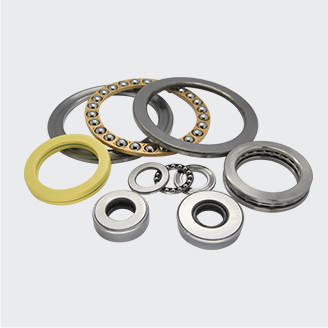
Yes, moderate axial loads in both directions, though heavy axial demands are better served by angular contact or thrust bearings.
Sealed designs greatly reduce lubrication and contamination maintenance, but periodic inspection is still recommended for critical equipment.
When operating speed, heat sensitivity, or friction reduction requirements exceed what standard chrome steel bearings can comfortably deliver.
Our provided products
Contact Us
Tel: +86-13916786238
Fax: +86-21-68551629
Email: [email protected]
Add: HuangXu Industrial Area, DanTu, ZhenJiang city, JiangSu Province, China
Industries


 English
 日本語
日本語
 Français
 Español