Precision Bearing Guide
Most rotating equipment failures trace back to one undersized or mismatched component: the bearing. A deep groove ball bearing is the default choice across motors, pumps, and machinery for good reason — but choosing the wrong variant for the load, speed, or environment still shortens service life fast.
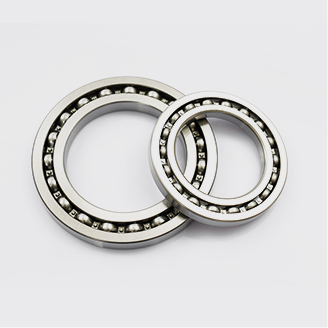
Structure Inner ring, outer ring, rolling balls, and a cage that spaces them evenly — this simple four-part structure is what lets deep groove bearings carry both radial and axial loads at once.
Why Deep Groove Ball Bearings Are So Widely Used
-
Combined load handling — carries radial and axial loads simultaneously, unlike bearings built for one load type only.
-
Low friction rotation — smooth operation reduces energy loss and heat buildup.
-
High speed capability — suited to motor and spindle applications running at elevated RPM.
-
Low noise and vibration — precision-ground components keep operation quiet under load.
-
Long service life — reliable performance across extended duty cycles when correctly specified.
Where These Bearings Are Used
Electric MotorsHigh-speed radial support for motor shafts across industrial and consumer equipment.
AutomotiveTransmission and drivetrain components requiring reliable rotation under variable load.
Industrial MachineryCore rotating support across manufacturing and factory automation equipment.
Pumps & CompressorsContinuous-duty rotating equipment where friction loss directly affects efficiency.
Bearing Types by Application
| Single Row |
General machinery, electric motors, standard mechanical systems |
| Double Row |
Higher radial load applications and heavy mechanical equipment |
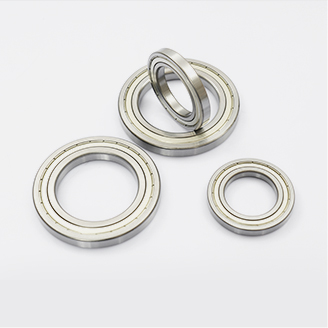
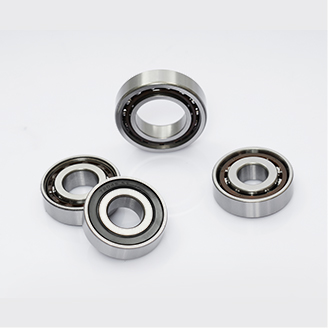
| Shielded |
Dry environments and high-speed rotating equipment |
| Sealed |
Contaminated environments requiring maintenance-free operation |
Selection Factors That Matter Most
-
Load capacity — match rated radial and axial load to actual operating conditions.
-
Operating speed — confirm the bearing is rated for the equipment's RPM range.
-
Environment — factor in temperature, contamination, and corrosion exposure.
-
Dimensional fit — verify bore, outer diameter, and width against shaft and housing specs.
-
Lubrication needs — sealed designs reduce maintenance; open designs need scheduled service.
Deep Groove vs Roller vs Angular Contact Bearings
Deep Groove
- Combined radial and axial load capacity
- Lower friction, higher speed rating
- Best general-purpose choice
Roller Bearing
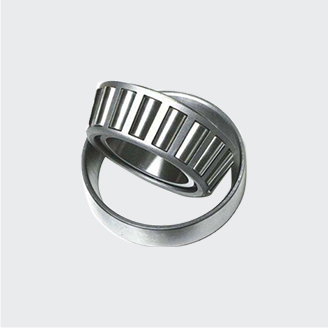
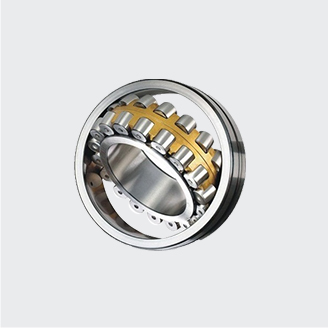
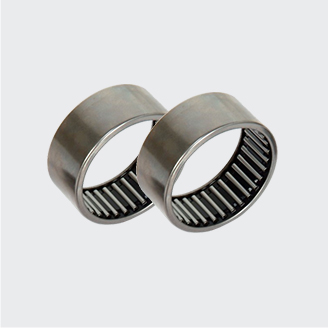
- Higher radial load capacity
- Lower speed tolerance
- Best for heavy, slow-moving loads
Angular Contact
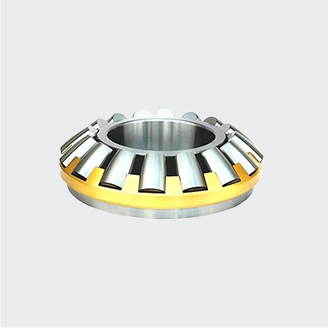
- Higher axial load capacity
- Precise, one-direction thrust support
- Best for spindle and precision applications
Common Causes of Premature Bearing Failure
Most field failures come down to four preventable issues: lubrication breakdown that increases friction and heat, sustained overloading beyond rated capacity, contamination or corrosion in unsealed applications, and incorrect installation that misaligns the shaft. Specifying the right bearing variant up front eliminates most of these risks before they start.
Choosing a Reliable Bearing Supplier
Sourcing a deep groove ball bearing reliably depends on more than the spec sheet. Confirm the manufacturer's material quality control, heat treatment consistency, and testing standards, and make sure customization and technical support are available for equipment with non-standard requirements.


 English
 日本語
日本語
 Français
 Español