Industry Trends
2025-12-18
Content
The selection of stainless steel deep groove ball bearings is fundamental for machinery operating in hostile environments characterized by high humidity, constant moisture exposure, or demanding food and beverage processing standards. While the bearing rings and balls (typically made from AISI 440C or 300 series stainless steel) provide the necessary corrosion resistance, the actual service life and performance stability are often dictated by two non-metallic components: the seals and the lubricant. The seals must prevent water and cleaning agents from reaching the core components while retaining the lubricant, particularly in the case of specialized H1 food-grade greases.
Shanghai Yinin Bearing & Transmission Company has evolved into an integrated industry and trade enterprise, focusing on providing the highest quality bearings. Our technical expertise ensures that every component—from the stainless steel core to the customized seal—is perfectly matched, addressing the critical issue of Seal material compatibility for stainless steel deep groove ball bearings from the design stage onward.
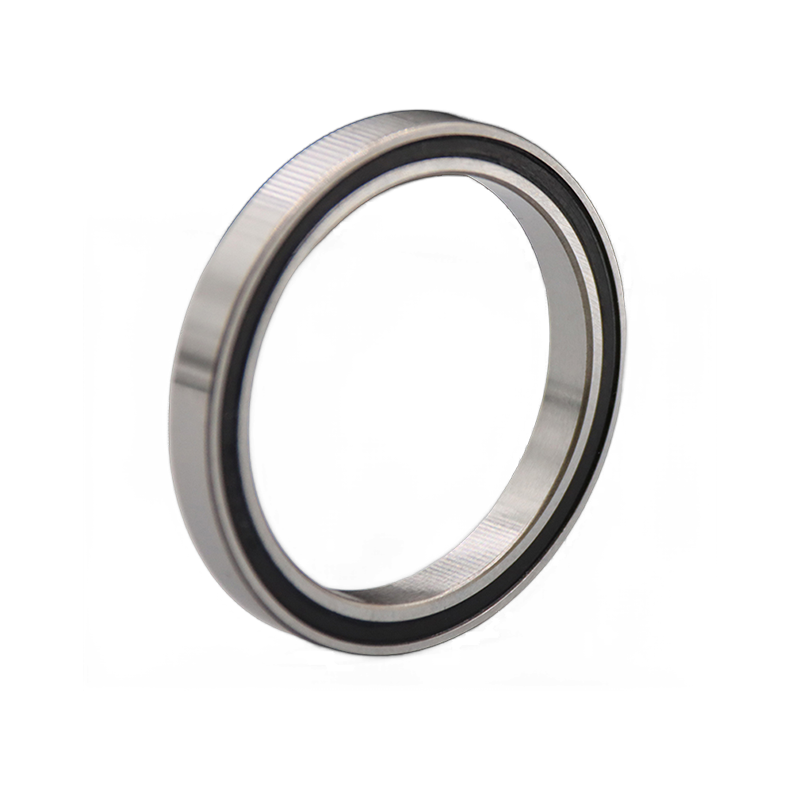
Choosing the correct seal material is an engineering trade-off involving temperature capability, rotational speed, and, most importantly, chemical inertness to cleaning agents (detergents, sanitizers) and process fluids.
Elastomer seals commonly used include NBR (Nitrile Butadiene Rubber), FKM (Fluoroelastomer), and the polymer PTFE (Polytetrafluoroethylene). NBR is cost-effective and suitable for oil resistance in general industrial settings but exhibits poor tolerance to high heat (typically > 100°C) and aggressive chemicals often found in food processing wash-downs. FKM offers superior chemical resistance and operates effectively at high temperatures (up to 200°C intermittent), making it highly suitable for high-humidity applications involving intermittent heat and mild chemicals. PTFE, while less elastic, provides the highest chemical inertness and widest temperature range, often mandatory where Chemical resistance of stainless steel bearing seals to strong acids or bases is required, despite lower elasticity.
| Seal Material | Operating Temperature Range (Typical) | Resistance to Strong Chemicals/Solvents | Elastomer Suitability for High Humidity |
|---|---|---|---|
| NBR (Nitrile) | -30°C to 100°C | Poor to Moderate | Moderate (Prone to degradation by oxidizing cleaners) |
| FKM (Fluoroelastomer) | -20°C to 200°C | Excellent | Excellent (Resists common wash-down chemicals) |
| PTFE (Polymer) | -70°C to 250°C | Superior (Chemically Inert) | Superior (Best Chemical resistance of stainless steel bearing seals) |
For demanding applications, the selection often narrows down to FKM or PTFE. While NBR is cheaper, its swelling when exposed to certain synthetic greases or its failure under steam cleaning render it unsuitable for ensuring the long-term integrity of stainless steel deep groove ball bearings in high-compliance settings.
The chosen lubricant, especially H1 food-grade grease, must be chemically stable when in continuous contact with both the stainless steel surface and the seal material, without compromising its sealing function.
H1 greases are formulated with non-toxic, food-safe base oils (often PAO or silicone) and thickened with agents like Calcium Sulfonate or PTFE. The critical check is chemical compatibility. Certain grease additives or base oil components can cause elastomers to harden, crack, or—most commonly—swell excessively, leading to increased friction or seal failure. Therefore, verifying H1 food grade grease compatibility with FKM seals is essential, as FKM's robust structure generally tolerates the synthetic PAO base oils better than NBR, preventing volume change and loss of sealing force.
For applications where sanitation involves hot water or steam (high-temperature wash-down), the lubricant must maintain its viscosity and adhere to the bearing components. High-viscosity H1 greases with advanced thickeners offer superior resistance to water washout. When Selecting stainless steel bearing lubricant for high temperature, the grease's dropping point must significantly exceed the maximum operating temperature, often requiring the use of silicone-based H1 greases or high-quality synthetics to ensure structural integrity across the operating spectrum.
Long-term reliability for B2B procurement is achieved through systematic validation of component interaction.
While the primary function of the stainless steel deep groove ball bearings is corrosion resistance, the seal is the weak link. The risk is less about the grease degrading the steel, and more about the grease or environment degrading the seal, leading to lubricant leakage and water intrusion. Therefore, engineers must focus testing on the Chemical resistance of stainless steel bearing seals to the most aggressive cleaning agent used in the facility, not just the grease.
Shanghai Yinin's technical team provides comprehensive bearing design and production services. For customized, non-standard high-end bearings designated for food or high-humidity environments, we ensure that the required seal (e.g., PTFE or FKM) and the H1 lubricant are verified against standardized compatibility charts and internal testing procedures. This commitment to quality, technology, and service guarantees the functional longevity of the final product.
Optimal performance of stainless steel deep groove ball bearings in high-demand environments relies on careful evaluation of all components as a system. This means prioritizing Seal material compatibility for stainless steel deep groove ball bearings by choosing FKM or PTFE, verifying H1 food grade grease compatibility with FKM seals, and ensuring the lubricant selection accounts for both high temperature and frequent wash-down cycles. For B2B purchasers, demanding this level of engineered precision is the key to minimizing downtime and maximizing equipment reliability.
Our provided products
Contact Us
Tel: +86-13916786238
Fax: +86-21-68551629
Email: [email protected]
Add: HuangXu Industrial Area, DanTu, ZhenJiang city, JiangSu Province, China
Industries


 English
 日本語
日本語
 Français
 Español