Industry Trends
2025-12-25
Content
The contemporary industrial environment increasingly demands components that offer both exceptional resilience to corrosion and superior dynamic performance. Stainless steel deep groove ball bearings, typically constructed from AISI 440C for rings and balls, are the standard choice for applications exposed to moisture, mild acids, or stringent wash-down cycles. However, for high-speed operation or equipment where acoustic emissions are critical (e.g., medical devices, specialized motors), corrosion resistance must be successfully integrated with high rotational accuracy and minimal noise/vibration (V/N) output.
Shanghai Yinin Bearing & Transmission Company operates as an integrated industry and trade enterprise, delivering customized and high-end bearing solutions. Our focus is on providing products where component quality and precision meet the demanding operational criteria, ensuring that our stainless steel deep groove ball bearings perform reliably across all specified V/N and tolerance grades.
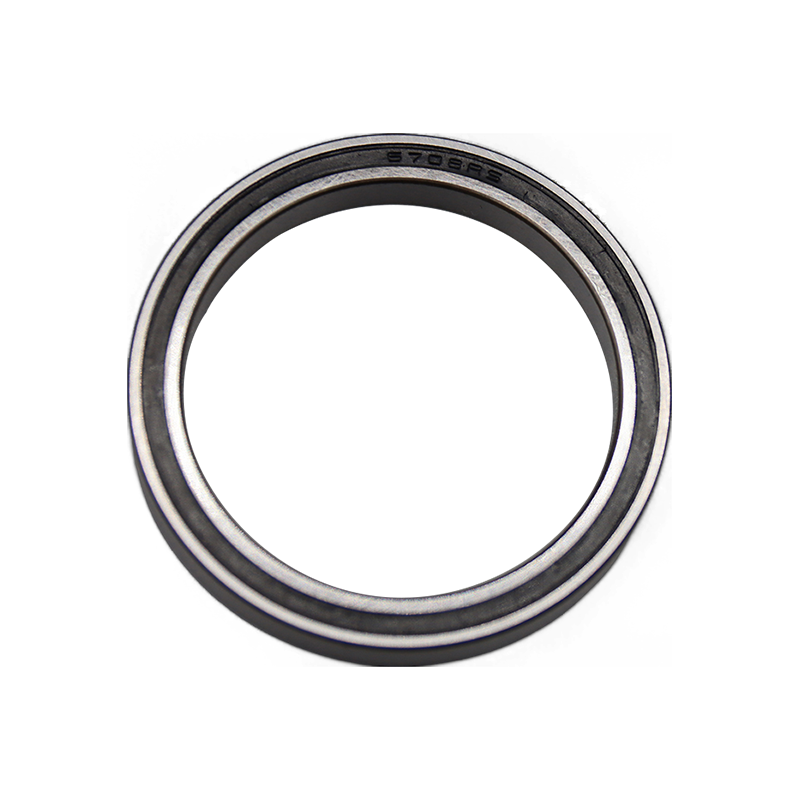
The tolerance grade, defined by international standards (ABEC in the US, ISO/JIS in Europe/Asia), directly dictates the geometric precision of the bearing's components. Higher precision minimizes dynamic imbalance and rotational runout, which are precursors to high-frequency vibration and noise.
Tolerance grades range from ABEC-1 (P0, standard industrial) to ABEC-5 (P5) and higher. Selecting the correct grade is a function of the operational speed (rotational speed vs. limiting speed) and the required noise profile. For applications operating at moderate speeds (below 50% of limiting speed), ABEC-1 is typically sufficient. However, for high-speed operation (exceeding 60% of limiting speed), the centrifugal and dynamic forces mandate higher precision.
To ensure high rotational stability and minimize vibration induced by geometric inaccuracies like inner and outer ring runout, ABEC tolerance selection for high speed stainless steel bearings typically starts at ABEC-3 (P6). Precision is paramount for Selecting high precision stainless steel bearings for low noise, as microscopic deviations are amplified at high RPMs, generating unwanted noise.
Higher ABEC grades are achieved through extended and more controlled grinding and finishing processes, leading to a direct cost increase. B2B engineers must justify the premium by the necessity for reduced noise or enhanced rotational accuracy.
| ABEC/ISO Grade | Typical Application Speed | Impact on Noise/Vibration | Cost Premium (Relative) |
|---|---|---|---|
| ABEC-1 (P0) | Low to Moderate Speed | Standard V/N Grade (V0/Z0) | 1.0X (Baseline) |
| ABEC-3 (P6) | Moderate to High Speed | Improved V/N Grade (V2/Z2) | 1.5X - 2.5X |
| ABEC-5 (P5) | High Speed, Low Noise | Low V/N Grade (V3/Z3 or Higher) | 2.5X - 5.0X |
While tolerance defines geometric accuracy, the raw material properties of stainless steel directly influence the bearing's V/N performance, especially the material's damping capability and surface finish attainment.
The Impact of stainless steel on bearing noise and vibration is subtle but measurable. Standard AISI 440C stainless steel, while hardenable, often possesses a slightly lower elastic modulus and lower attainable hardness limit compared to through-hardened chrome steel (SAE 52100). This inherent material difference can result in slightly reduced rigidity and lower damping capacity, making the bearing potentially more susceptible to transmitting structure-borne noise, unless compensated for by superior manufacturing.
V/N grades (often designated as Z1, Z2, Z3 or V1, V2, V3, V4, with higher suffixes indicating lower noise/vibration output) are measured on specialized instruments (like BVT or S90/V012 systems) by quantifying vibration velocity across low, medium, and high-frequency bands. Achieving low noise (V3/Z3 or V4/Z4) in stainless steel deep groove ball bearings requires mitigating these material effects.
Meeting stringent Vibration grade standards for stainless steel deep groove ball bearings is primarily achieved through achieving ultra-smooth raceway surfaces. This 'super-finishing' minimizes the high-frequency vibrations generated by the rolling elements (balls) passing over microscopic surface asperities. For applications requiring a V3 or V4 grade, the waviness and roughness of the raceway must be minimized to levels significantly below what is required for the geometric tolerance (ABEC grade) alone.
The complexity of achieving high-precision, low-noise stainless steel bearings lies in the manufacturing processes specifically adapted for the material.
To overcome the inherent challenges in Impact of stainless steel on bearing noise and vibration, specialized abrasive techniques are required. High-precision grinding minimizes macro-geometry errors, while super-finishing (honing or polishing) of the raceways and rolling elements is essential for achieving the mirror-like finish necessary for low-noise operation. This level of surface control is what allows manufacturers to successfully supply Selecting high precision stainless steel bearings for low noise for demanding customers.
A critical consideration for B2B buyers is the trade-off between corrosion resistance and precision. While 440C offers good hardness, other highly corrosive-resistant grades (like 316 stainless) are significantly softer. Achieving high precision (ABEC-5) in 316 stainless is technically challenging and involves a substantial cost premium because the material is prone to smearing during grinding, affecting the required geometric accuracy for high-speed operation. Therefore, balancing the required corrosion resistance with the necessary dynamic performance involves navigating this Corrosion resistance versus precision in stainless steel bearings trade-off.
The optimal specification for stainless steel deep groove ball bearings is not determined by corrosion resistance alone. It requires a detailed engineering assessment to link the application's speed and noise limits to the required tolerance and V/N grades. By choosing the appropriate ABEC tolerance selection for high speed stainless steel bearings (ABEC-3 or higher) and demanding validated Vibration grade standards for stainless steel deep groove ball bearings (V3/Z3 or higher), engineers can ensure the component delivers reliable, quiet, and long-lasting performance in the most demanding industrial settings.
Our provided products
Contact Us
Tel: +86-13916786238
Fax: +86-21-68551629
Email: [email protected]
Add: HuangXu Industrial Area, DanTu, ZhenJiang city, JiangSu Province, China
Industries


 English
 日本語
日本語
 Français
 Español