Industry Trends
2026-09-30
Content
When an industrial pump fails twice in one quarter, the replacement decision moves from a routine parts order to an engineering judgment. The first question is usually whether to fit a single row or a double row deep groove ball bearing. The short answer: keep the single row as your default because it runs faster, cooler, and quieter for the same bore size, and choose a double row only when you need sharply higher radial load capacity, extra stiffness, or better resistance to tilting moments in a housing bore you cannot enlarge.
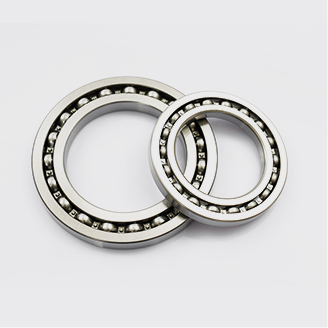
Geometry drives every performance difference between the two types. A single row deep groove ball bearing carries one row of balls in deep, continuous raceway grooves ground into both rings. The deep grooves allow it to accept moderate axial loads from either direction as well as radial loads, which is why this format dominates electric motors, pumps, gearboxes, and household appliances. The familiar families are the 6000, 6200, 6300, 6400, 6800, and 6900 series.
A double row deep groove ball bearing places two rows of balls side by side in a shared inner ring and outer ring. In effect, it behaves like two single row bearings combined into one wider package. For the same bore diameter, the double row unit is wider and heavier, and the load spreads across roughly twice as many balls. True double row deep groove series, the 42xxx and 43xxx families, are manufactured, but they are far less commonly stocked than single row lines.
One procurement trap deserves attention: many catalogues that advertise a double row deep groove ball bearing are actually offering a double row angular contact ball bearing, such as the 5200, 5300, or 3000A series. Angular contact raceways shift the load and speed balance, and the difference affects ratings. Confirm which geometry the spare part drawing requires before you order, because the two types are not interchangeable in life calculations.
Radial load is where the double row earns its keep. For the same bore, a double row ball bearing raises the basic dynamic load rating C by roughly 40 to 70 percent compared with a single row, because about twice as many balls share the load. The price is width: the double row is typically one-third to more than half wider than a single row of the same bore. If the housing has room, you gain a substantially heavier-duty support point without changing the shaft diameter.
The table below compares a typical 25 mm bore pair to show the scale of the trade-off.
| Parameter | Single row 6205 | Double row 5205 |
|---|---|---|
| Bore | 25 mm | 25 mm |
| Outside diameter | 52 mm | 52 mm |
| Width | 15 mm | 20.6 mm |
| Basic dynamic load rating C | about 14.8 kN | about 21.0 kN |
| Limiting speed, grease lubrication | about 12,000 rpm | about 8,500 rpm |
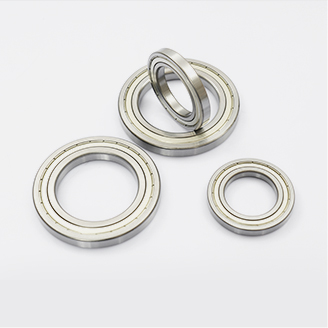
For shaft sizes roughly between 25 and 60 mm, the 6200 series single row deep groove ball bearings from the catalogue cover the majority of industrial replacement positions, and they are the baseline against which any double row should be judged.
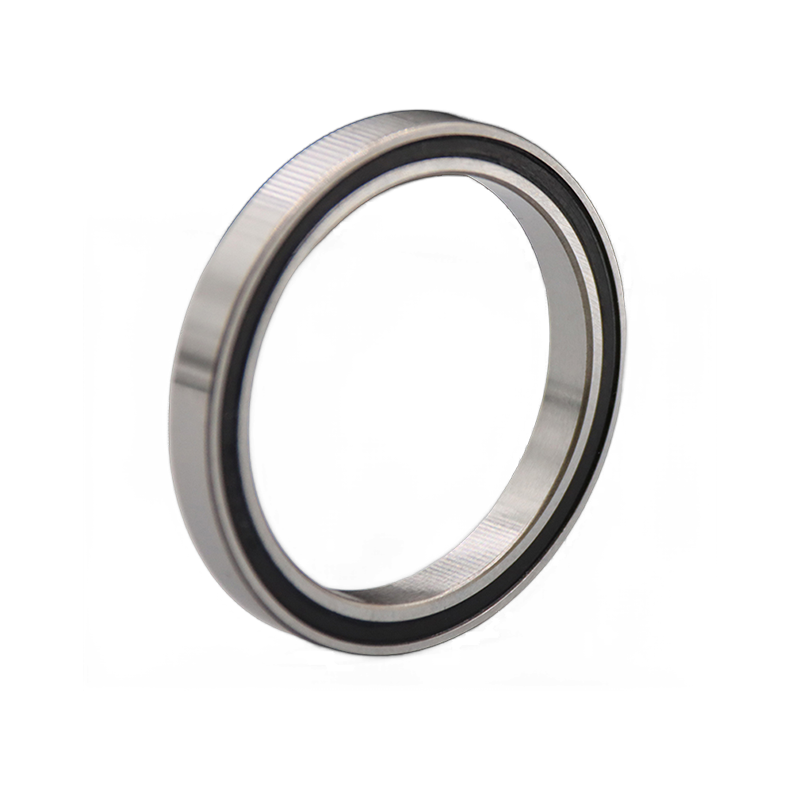 Custom 6200 Series Deep Groove Ball Bearing Manufacturers, FactoryShanghai Yinin Bearing & Transmission Company Is China 6200 Series Deep Groove Ball Bearing Manufacturers and custom 6200 Series Deep G...View Product →
Before committing to a double row, check whether a larger single row solves the problem with less compromise. A 6300 series deep groove ball bearing with a 25 mm bore, the 6305, reaches a dynamic rating close to the 5205 while keeping the speed margin of a single row, at the cost of a larger housing bore.
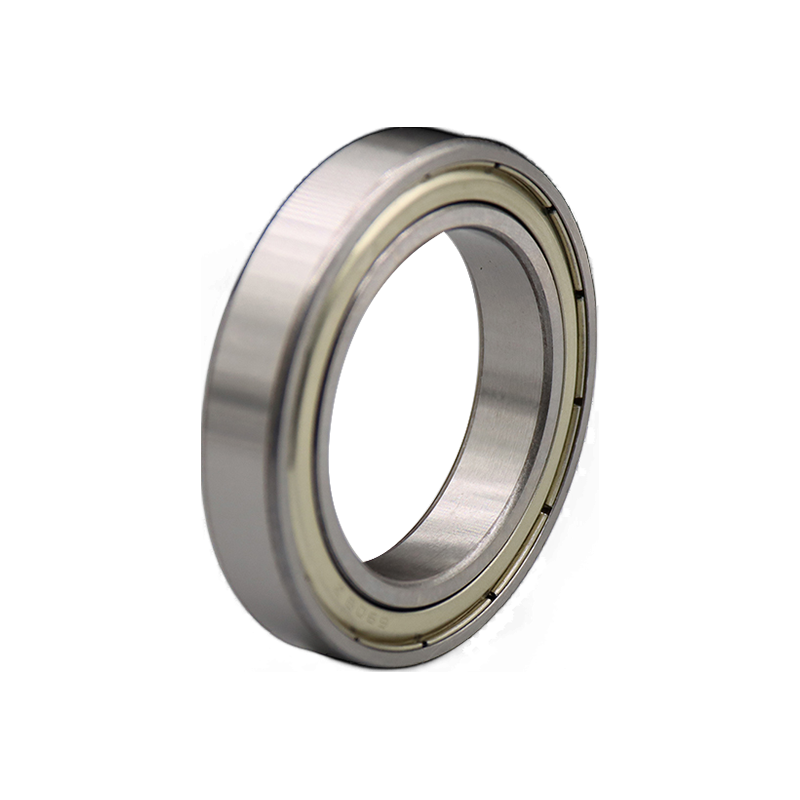 Custom 6300 Series Deep Groove Ball Bearing Manufacturers, FactoryShanghai Yinin Bearing & Transmission Company Is China 6300 Series Deep Groove Ball Bearing Manufacturers and custom 6300 Series Deep G...View Product →
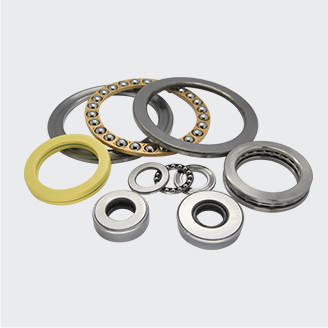
Single row deep groove bearings handle moderate axial loads from both directions thanks to their high, symmetrical raceway shoulders. A double row raises total axial capacity for the same bore, but the gain is modest because each row contributes separately. If the machine applies a heavy axial load in one direction only, a single row angular contact bearing or a thrust bearing is usually the better solution.
Moment resistance is a different story. The wide spread of ball contact points in a double row gives it far greater resistance to tilting moments. Overhung pulleys, cantilevered impellers, and short gearbox shafts all take advantage of this. A single row of the same bore acts like a narrow pivot and deflects more under the same moment load.
Speed is where the single row fights back. Two rows mean more balls, more rolling resistance, more grease churning, and more heat. For the same bore and lubrication, the double row limiting speed typically sits 20 to 35 percent below the single row value. At 3,000 rpm in a standard motor, the difference is irrelevant; in a high-speed fan or spindle, it decides the bearing.
Friction torque follows the same pattern. A double row draws slightly more drive power and runs a few degrees hotter. In heat-sensitive applications, plastic fans, food equipment, and small motor windings, the thermal gap changes the reliability calculation. If you must run a double row near the top of its range, specify C3 clearance, choose a grease matched to the operating temperature, and verify housing temperature rise during commissioning.
Under deflection measurement, the double row wins in most shaft support arrangements. The wide contact spread resists shaft bending and holds the shaft axis stable, which is why double row ball bearings appear in machine tool feed mechanisms, hoist drums, and impeller shafts. A pair of single row bearings preloaded against each other can match this stiffness, but the arrangement costs more and uses more housing space.
Single row deep groove bearings tolerate a few arc-minutes of shaft angular misalignment, depending on clearance and load. Double row deep groove designs are less forgiving: misalignment loads one row heavily and shortens life quickly. If the housing flexes or the shaft deflects, stay with a single row or switch to a self-aligning type rather than forcing a double row into a misaligned bore.
For quiet-running equipment, the single row is the safer choice. Fewer balls interact with the raceways, and the enormous market volume of single row bearings means low-noise cages, greases, and raceway finishes are easier to source. Double row bearings show a slightly higher vibration level, particularly at moderate speeds. In household appliances, medical equipment, and office automation, keep the single row unless the load margin forces the double row.
Single row deep groove ball bearings cover the largest share of rotating machinery: electric motors, pumps, compressors, fans, conveyor rollers, gearboxes, and general industrial drives. The same families appear across the automotive sector in accessory drives, transmission positions, and wheel-end assemblies; the company's automotive industry page documents these mounting contexts.
Double row ball bearings show up where radial load is high relative to shaft size and the housing bore cannot grow: compact gearboxes, hoist and pulley blocks, agricultural implements, textile machinery, and printing presses. Sealed double row units are valued in positions where maintenance access is difficult.
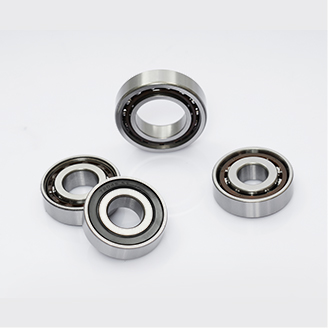
In daily replacement work, the part numbers most often used as double row deep groove substitutes come from the 5200 and 5300 series. The 5200 series double row angular contact ball bearings provide the same compactness and high radial capacity, and the defined contact angle adds a predictable axial load capability. When the drawing specifies a double row ball bearing for a moderate-speed, high-load position, this is the usual drop-in answer.
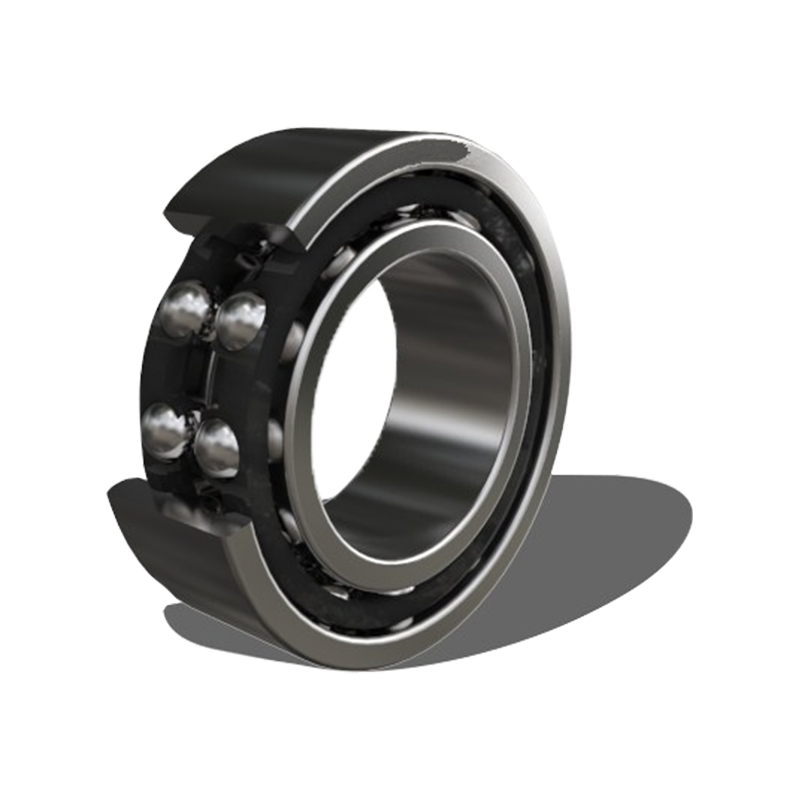 Custom 5200 Series Double Row Angular Contact Ball Bearings Manufacturers, FactoShanghai Yinin Bearing & Transmission Company Is China 5200 Series Double Row Angular Contact Ball Bearings Manufacturers and custom 5200...View Product →
Work through these steps in order, and the row-count question usually answers itself.
The scorecard below summarises the comparison.
| Criterion | Better option |
|---|---|
| Radial load in the same bore | Double row |
| Axial load in both directions | Single row, unless the double row contact angle is verified |
| Tilting moment resistance | Double row |
| Speed limit | Single row |
| Running temperature | Single row |
| Vibration and noise | Single row |
| Misalignment tolerance | Single row |
| Housing bore constraint | Double row |
| Width constraint | Single row |
| Availability and lead time | Single row |
For most machines, the single row deep groove ball bearing is the right starting point. It is dependable, economical, and easy to source. When the life calculation says the single row will not reach the required rating in the available envelope, move to a double row, or to a sealed double row angular contact unit if lubrication access is poor.
Before finalising a part number, review the deep groove bearing selection guide and the angular contact bearing comparison guide; both explain the ratings and operating limits that matter during procurement. Shanghai Yinin Bearing & Transmission Company supplies single row and double row ball bearing families across the catalogue, so engineering and purchasing teams can compare real stock availability instead of working from theoretical pages.
Our provided products
Contact Us
Tel: +86-13916786238
Fax: +86-21-68551629
Email: [email protected]
Add: HuangXu Industrial Area, DanTu, ZhenJiang city, JiangSu Province, China
Industries


 English
 日本語
日本語
 Français
 Español