Industry Trends
2026-10-21
Content
A 1.6 km overland conveyor at a copper mine in Chile was losing its tail pulley bearing every six weeks. The original deep groove ball bearing ran at 180 r/min under a measured 320 kN radial load, and the shaft sat 1.4 degrees out of line at the drive end. The replacement is a 22320 spherical roller bearing, and the position has now run for two continuous years on the same grease schedule. That decision sequence is what this guide documents, following the selection practice that Shanghai Yinin Bearing & Transmission Company applies to its spherical roller bearing range, from the compact 21300 series up to the heavy 24100 series.
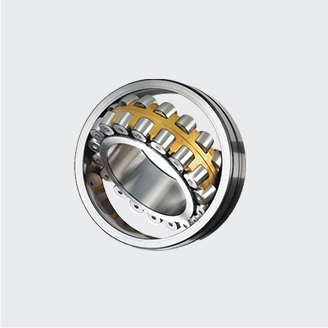
Radial load determines the bearing size; the shock level determines the series. A spherical roller bearing is a double-row rolling bearing with barrel-shaped rollers that run on a sphered outer raceway, which lets the shaft operate with up to about 2 degrees of angular misalignment while carrying heavy combined radial and axial loads in either direction.
Calculate the equivalent dynamic bearing load P before opening any catalogue. For a combined radial load Fr and axial load Fa, use the standard equation P = X x Fr + Y x Fa, where X and Y are the factors published for each bearing series. Then multiply the steady-state load by a service factor before comparing it with the dynamic load rating C: use 1.5-2.0 for belt conveyors, fans and gearboxes, and 2.0-3.0 for crushers, screens and presses. Vibrating screens in particular expose bearings to peak accelerations of 4-5 g, which a static load calculation never reveals.
Once P is known, the basic rating life follows from L10 = (C/P)^(10/3) million revolutions. The 10/3 exponent is the Weibull slope for line-contact roller elements, lower than the exponent 3 used for ball bearings, so roller bearings are more sensitive to small changes in load. The chart below shows why series selection matters: these are indicative dynamic load ratings for four spherical roller bearing series on the same 100 mm shaft.
Dynamic radial load rating C for 100 mm bore series, typical E-class variants.
For standard conveyor duty and moderate shock, common practice in construction and mining equipment is to start with the 22200 series, which gives the best ratio of load capacity to envelope size.
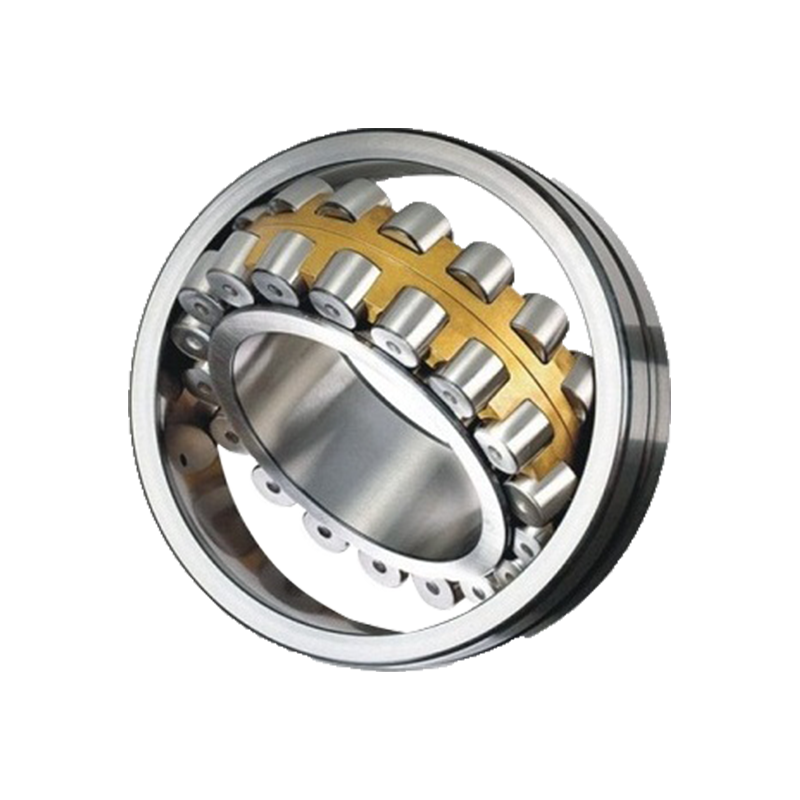 22200 Series Spherical Roller Bearing for Heavy Industrial UseThis series offers a balanced load capacity-to-size ratio, making it a practical first choice for conveyor and mining equipment. Its self-aligning design handles misalignment and moderate axial loads in both directions.View Product →
The limiting speed of a spherical roller bearing is set by cage geometry and roller mass, not by the bore diameter alone. A 22220 greases up to about 2,400 r/min, a 23120 reaches roughly 2,800 r/min, and a 22320 stops near 1,800 r/min because its larger rollers generate more centrifugal force.
When the operating speed exceeds about 70% of the limiting speed, switch from the standard pressed-steel cage to a machined brass cage. Brass runs cooler, survives marginal lubrication better, and tolerates the higher temperatures found in steel mills and cement plants.
Temperature sets the second boundary. Standard bearings operate from -30 °C to +120 °C; with heat-stabilized rings the same bearings run to +200 °C, but the selected internal clearance must be opened up to absorb the difference in expansion between shaft, ring and housing. For large rotating shafts in fans, pumps and generators, where speed matters more than ultimate load, the 23000 series is the correct starting point.
 23000 Series Spherical Roller Bearing for High-Speed Rotating ShaftsDesigned for large shafts in fans, pumps, and generators, this bearing prioritizes speed over ultimate load. It self-aligns to compensate for shaft deflection and supports heavy radial loads in demanding conditions.View Product →
More spherical roller bearings fail from wrong clearance and poor lubrication than from raw overload. Select the radial internal clearance before you confirm the fit. A tight shaft fit consumes 60-80% of the interference allowance of the mounted clearance, and the operator cannot see the loss until the housing starts running hot.
For grease lubrication, choose a grease whose base-oil viscosity matches the speed and temperature: typically ISO VG 220 for an 80-150 mm bore bearing running at 60-90 °C, and ISO VG 320-460 for circulating-oil systems in rolling mills and heavy presses. Relubrication intervals run from about 500 hours of continuous heavy service up to 4,000 hours for lightly loaded clean positions.
The same bore size can carry almost double the load when you step from a 22200 series to a 22300 series, so never freeze the series before the shaft diameter and housing layout are fixed. The comparison below is the selection table used for most heavy industrial positions.
| Series | Roller design | Cr, 100 mm bore | Speed limit | Typical heavy-duty position |
| 22200 | Standard double-row | about 285 kN | 2,400 r/min | Conveyors, fans, gearboxes |
| 22300 | Oversized rollers in same OD | about 540 kN | 1,800 r/min | Crushers, screens, presses |
| 23000 | Slim rollers, higher speed | about 345-485 kN | 2,800 r/min | Pumps, turbines, large motors |
| 23200 | Widened 23000 profile | about 520 kN | 2,000 r/min | Heavy vibratory machines |
| 24000/24100 | Extra-wide, huge rollers | above 600 kN | 1,200-1,500 r/min | Rolling mills, kilns, rope sheaves |
When the deciding factor is resistance to shock and vibration, the 22300 series is the usual answer. Its oversized rollers spread the contact stress over a larger area, which is exactly what a crusher head or a vibrating screen deck demands. For the largest kilns and mills, the 24000 and 24100 series are the only practical solution.
 22300 Series Spherical Roller Bearing for Shock and VibrationFeaturing oversized rollers that spread contact stress, this series suits crusher heads and vibrating screens. It resists impact loads and misalignment while reducing friction and heat generation in harsh environments.View Product →
A bearing is only as reliable as the shaft seat, the housing seat and the lubrication that surround it. Before mounting, measure both seats for roundness and taper: a deviation above IT5/2 on the shaft journal will distort the inner ring and show up as a hot spot within the first hour of running.
Use a press fit on the rotating ring: for a rotating inner ring, select a shaft tolerance of p6 or r6; for a rotating outer ring, the housing fit should be K7 or M7. Mount with an induction heater and never hammer on the ring face. Record the internal clearance before and after mounting, and confirm the reduction matches the expected 60-80% of the press-fit allowance. After the first hour, the housing temperature should settle in the 60-90 °C range; a climb beyond 100 °C means the clearance class or the lubricant is wrong.
Straight answers to the questions that come up most often when spherical roller bearings are specified for heavy industrial equipment.
Both series cover the same shaft diameter range, but a 22300 bearing uses considerably larger rollers. At a 100 mm bore the 22320 carries a dynamic load rating near 540 kN, while the 22220 is around 285 kN. Choose 22300 for crushers, screens and presses; choose 22200 for conveyors and fans.
Spherical roller bearings support combined loads in both axial directions. With a moderate radial load, the usable axial load is roughly one-third of the dynamic radial rating. Above that, verify the X and Y factors from the catalogue, because the ratio of axial to radial load affects the equivalent load P directly.
Standard series tolerate up to 2 degrees of static angular misalignment between the shaft and housing centerlines, and some light-series designs reach 3 degrees. This allowance covers shaft deflection and mounting error, not a bent shaft or a settling foundation. Check the contact pattern after the first run if the application is close to the limit.
A grease-lubricated spherical roller bearing on a 180 r/min conveyor pulley typically needs regreasing every 1,000-2,000 operating hours, and each regrease should purge 10-15% of the grease volume. Hot, slow rollers in kilns may need regreasing every 500 hours, while clean fan duty can stretch to 4,000 hours. Oil-lubricated systems are best managed by regular oil analysis.
Our provided products
Contact Us
Tel: +86-13916786238
Fax: +86-21-68551629
Email: [email protected]
Add: HuangXu Industrial Area, DanTu, ZhenJiang city, JiangSu Province, China
Industries


 English
 日本語
 Français
 Español