Industry Trends
2026-07-16
Content
A deep groove ball bearing is the workhorse of rotating machinery: a compact rolling-element component that keeps shafts turning smoothly while carrying both radial and moderate axial loads. Its simple geometry hides a surprisingly wide performance envelope, which is exactly why it shows up in everything from household appliances to heavy industrial pumps. This guide breaks down how the design works, why engineers keep specifying it, and how to choose and maintain one correctly.
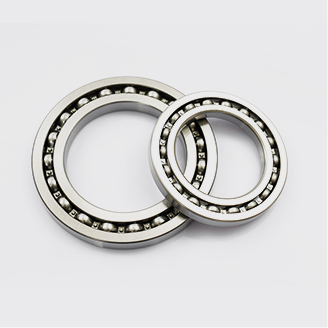
A deep groove bearing consists of four core parts: an inner ring, an outer ring, a set of rolling balls, and a cage that keeps those balls evenly spaced. The defining feature is the raceway itself — a groove machined deeper than the ball radius, which lets the ball sit further into the track than in a shallow-groove design.
That deeper seat is what gives the bearing its dual-load personality. As the inner ring rotates relative to the outer ring, the balls roll along the raceway, converting sliding friction into rolling friction. Because the groove wraps further around each ball, the bearing can resist forces pushing sideways along the shaft axis, not just forces pushing straight down on it.
A deep groove ball bearing is a rolling element bearing whose raceway curvature is deeper than the ball radius, allowing it to carry combined radial and axial loads in a single, low-maintenance unit.
Ask any mechanical engineer to name a default bearing choice, and this design is usually the first answer. The reasons come down to a rare combination of simplicity and versatility.
Because the same basic design scales from a few millimeters in diameter up to sizes fit for heavy industrial shafts, manufacturers rarely need to redesign around a different bearing family when specifications change slightly. That standardization keeps inventory simple for distributors and keeps repair timelines short for equipment owners.
Four traits explain most of this bearing's popularity, and each one solves a distinct engineering problem.
Rolling contact instead of sliding contact means less energy is wasted as heat, which matters directly to the operating efficiency of any motor-driven system.
The same low-friction geometry allows shafts to spin at higher rotational speeds before thermal or vibration limits become a concern, making the bearing a natural fit for motors, fans, and spindles.
Consistent load distribution across the raceway reduces localized wear, which translates into a longer interval between replacements when the bearing is properly lubricated and protected from contamination.
Because the design does not require the additional axial hardware that some specialized bearings need, it integrates into existing housings without forcing a redesign of surrounding components.
Beyond the bearing itself, the real payoff shows up at the system level. Reducing rolling resistance between moving parts lowers the total energy a motor needs to overcome just to keep a shaft turning. That translates into steadier operational stability under load, since the bearing absorbs both the radial pull of gravity and the axial thrust generated by belts, gears, or fluid pressure.
Continuous, low-vibration rotation also protects adjacent components — seals, shafts, and couplings all experience less fatigue when the bearing supporting them runs true. In practice, that means fewer unplanned stoppages and more predictable maintenance scheduling, both of which matter more to plant operators than the bearing's price tag alone.
From vehicle transmissions to kitchen appliances, this bearing family sits inside nearly any machine with a rotating shaft.
Transmission systems, alternators, and various drivetrain components rely on the bearing's ability to handle combined radial and axial loads inside a compact housing.
Motor and generator shafts spin continuously, often at high speed, making low-friction rotation a direct contributor to electrical efficiency.
Pumps, compressors, and general machinery systems use these bearings to support shafts that must run reliably across long production shifts.
Rotating components in appliances benefit from the same compact, low-maintenance qualities that make the bearing attractive in heavier industrial settings, just scaled down.
High-speed rotating equipment punishes any component that generates excess friction or heat. The optimized raceway curvature in this bearing design spreads contact stress evenly, keeping rolling resistance low even as rotational speed climbs. That translates into smoother rotation, less vibration-induced wear, and stable operation across the continuous movement that high-speed spindles, fans, and motors demand.
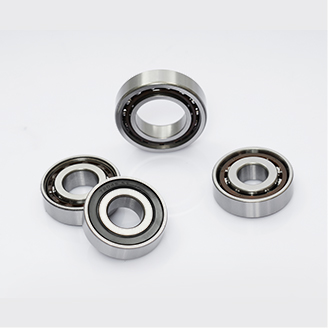
The most common configuration, built for general industrial use where a balanced mix of radial and axial capacity is enough. It is the default starting point for most bearing selection processes.
Two rows of balls share the load, giving the bearing higher load capacity in the same general footprint — useful where a single row would be undersized.
Scaled-down versions of the same design serve compact equipment where space is the primary constraint, such as small motors and precision instruments.
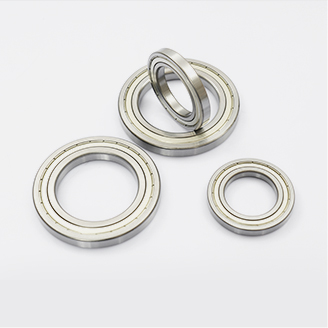
Built for corrosion-resistant environments, these variants trade a small amount of raw hardness for the ability to operate in humid, washdown, or chemically exposed settings.
Choosing the right deep groove ball bearing is less about picking the biggest or cheapest option and more about matching the bearing to the operating environment it will actually face.
| Selection Factor | Why It Matters |
| Load requirements | Determines whether single row or double row capacity is needed |
| Rotational speed | Higher speeds demand tighter tolerances and better lubrication |
| Operating environment | Dust, moisture, or chemical exposure may call for sealed or stainless variants |
| Temperature conditions | Extreme heat or cold affects lubricant choice and material selection |
| Lubrication method | Grease versus oil affects maintenance intervals and speed limits |
| Bearing dimensions | Must match housing and shaft tolerances precisely |
| Service life requirements | Sets expectations for inspection and replacement scheduling |
Consistent, correctly sized lubrication reduces internal friction and prevents premature raceway wear.
Keeping dust, moisture, and debris out of the bearing housing avoids abrasive wear on the raceway and balls.
Scheduled checks catch early signs of noise, vibration, or heat before they turn into failures.
Misalignment during installation is one of the most common causes of early bearing failure, and it is entirely preventable.
Running a bearing beyond its rated load, even briefly, accelerates fatigue and shortens service life.
Consistent performance starts long before the bearing reaches a customer. Manufacturing quality control typically moves through five stages: material selection, precision machining, heat treatment, assembly, and performance testing. Each stage narrows the margin for error, since a flaw introduced early — such as an inconsistent raceway surface — cannot be corrected later in assembly.
Testing generally covers dimensional accuracy, rotation performance, load capacity, and durability under simulated operating conditions. Bearings that fall outside tolerance at any stage are set aside before they ever reach a production line, which is why sourcing from a manufacturer with documented quality processes matters as much as the raw specification sheet.
Bearing development continues to move in a few consistent directions: improved material technology for better wear resistance, higher precision manufacturing tolerances, longer achievable service life, and energy-efficient designs that reduce the parasitic losses rotating equipment carries. Customized bearing solutions — tailored dimensions, coatings, or sealing arrangements for specific operating environments — are also becoming easier to source as manufacturers adopt more flexible production methods.
Our provided products
Contact Us
Tel: +86-13916786238
Fax: +86-21-68551629
Email: [email protected]
Add: HuangXu Industrial Area, DanTu, ZhenJiang city, JiangSu Province, China
Industries


 English
 日本語
日本語
 Français
 Español