Industry Trends
2026-11-25
Content
A 24,000 rpm motorized spindle holding 18 kW of cutting power keeps micron-level tool position because its angular contact ball bearings are specified, preloaded, and lubricated as a matched set. Get the combination wrong, and the machine loses stiffness, generates heat, and fails in the first thousand hours.
Angular contact ball bearings do more than rotate smoothly. Their offset raceways create a contact angle that converts applied load into defined axial and radial paths, which is exactly what high-speed precision machinery needs to resist cutting forces, thermal growth, and dynamic unbalance. Shanghai Yinin Bearing & Transmission Company supplies this bearing class in the 7000, 7200, 7300, and 7900 series, and the sections that follow explain what sets their speed limit, why preload decides stiffness, and how to apply them correctly.
An angular contact ball bearing supports combined radial and unidirectional axial loads at high rotational speed because the load line through the balls runs at a fixed angle to the bearing axis.
In an angular contact ball bearing, the inner and outer ring raceways are axially offset, so the line joining the two ball contact points forms a contact angle with the bearing axis. The geometry lets the bearing carry thrust in one direction while still supporting radial load, and that directional stiffness is what holds a spindle shaft in position.
The angled load path produces three effects that matter at speed:
The 7000 family covers the compact end of the range, with bore sizes from 10 mm upward and the same angular contact physics in a lighter envelope. Our angular contact ball bearing design and selection guide maps the dimensional relationships across every series in detail.
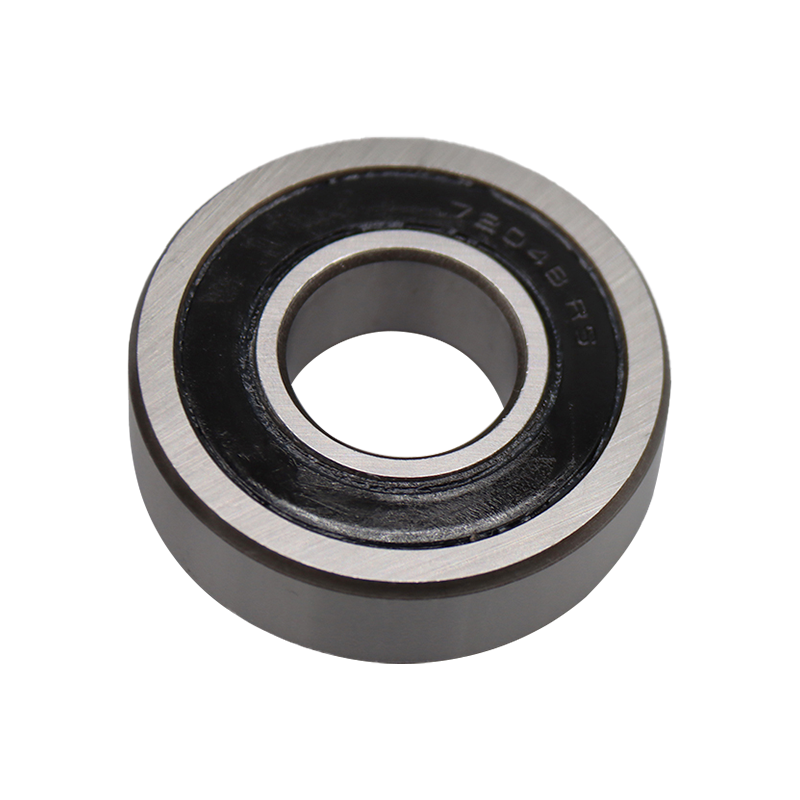 7000 Series Single Row Angular Contact Ball BearingsCompact bearings with bore sizes from 10 mm up, offering contact angles of 15, 25, or 40 degrees. Their angular contact design suits high-speed, high-stiffness applications like spindles and gearboxes.View Product →
Contact angle is the first specification decision: 15 deg, 25 deg, or 40 deg sets the balance between speed capability and axial load capacity, and no factory adjustment can change it afterwards.
| Contact angle | Speed capability | Axial load capacity | Typical spindle assignment |
| 15 deg (C type) | Highest | Lowest of the three | Ultra-high-speed grinding and milling |
| 25 deg (AC type) | High | Balanced | General machining centers, turning spindles |
| 40 deg (B type) | Moderate | Highest | Heavy cutting with dominant thrust loads |
A 15 deg contact maximizes speed because it produces the smallest spinning component at the contact ellipse; a 40 deg contact produces roughly 2.5 times the axial load capacity of a 15 deg design, but at a measurably lower speed limit. That single trade-off explains most angular contact selection decisions in machine design.
Rule of thumb: 15 deg for speed, 25 deg for balance, 40 deg for axial load. Do not specify 40 deg when the duty cycle is speed-dominated.
Bearing arrangement and preload class, not bearing size alone, determine how much a spindle deflects under cutting forces and how steadily it runs at speed.
DB back-to-back pair
High radial and axial stiffness with good overturning moment capacity. Thermal growth increases preload, so the environment must keep temperature under control at high speed.
DF face-to-face pair
Lower stiffness than DB, but preload stays more stable as temperature changes. Better suited to systems with thermal expansion between shaft and housing.
Preload class sets the baseline axial force between the rings and alters both stiffness and heat generation:
Matched pairs with defined preload classes are standard in the 7200 and 7300 families, and suppliers usually deliver them as pre-ground sets so the starting force is consistent from one spindle to the next.
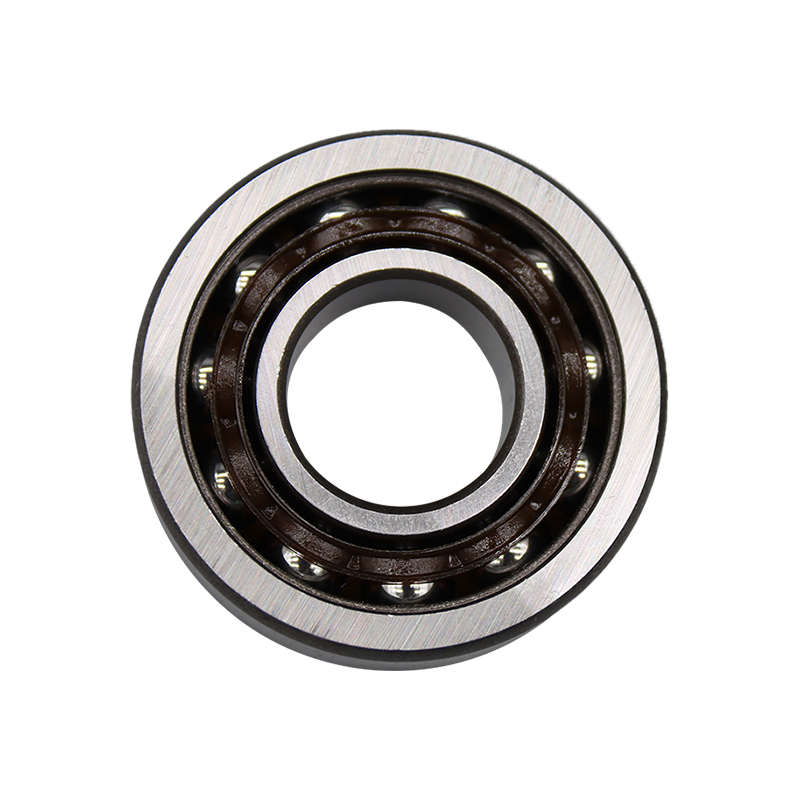 7200 Series Single Row Angular Contact Ball BearingsHigh-precision bearings optimized for speed and stiffness, available in matched pairs with preload classes. They handle radial and axial loads efficiently, making them suitable for machine tools and automation.View Product →
Cage design, lubrication method, and ball material define the practical speed ceiling of an angular contact ball bearing more than its static load rating does.
Worked example: a 70 mm bore angular contact pair at DN 600,000 runs about 8,570 rpm on oil-air; switching to hybrids and a 15 deg contact allows the same design to approach DN 900,000, or roughly 12,900 rpm.
Every rotating assembly that must hold axial position and run at elevated speed - machine tool spindles, aerospace actuators, medical handpieces - depends on angular contact ball bearings as the structural core.
| Application | Typical series | Key requirement |
| Motorized machine tool spindles | 7200 C / 7900 C | DB pairs, oil-air, runout below 2 microns |
| Aerospace actuation systems | 7900 series | Wide temperature range, high stiffness, low mass |
| Dental and surgical handpieces | 7000 miniature | Extreme rpm, grease-lifetime, low noise |
| Automotive e-drive shafts | 7000 / 7200 | Moderate speed, high axial load from gears |
Precision spindle work almost always returns to the same formula: a 15 deg or 25 deg contact, a DB arrangement, medium preload, and oil-air lubrication above DN 500,000.
Aerospace applications combine the speed margin of a 15 deg contact with tight tolerance classes because flight-control actuators must hold position through temperature swings and load reversals. Builders working to that standard use the 7900 series for its lightweight cage and optimized contact geometry. Our aerospace bearing applications page shows how these selections behave in flight hardware.
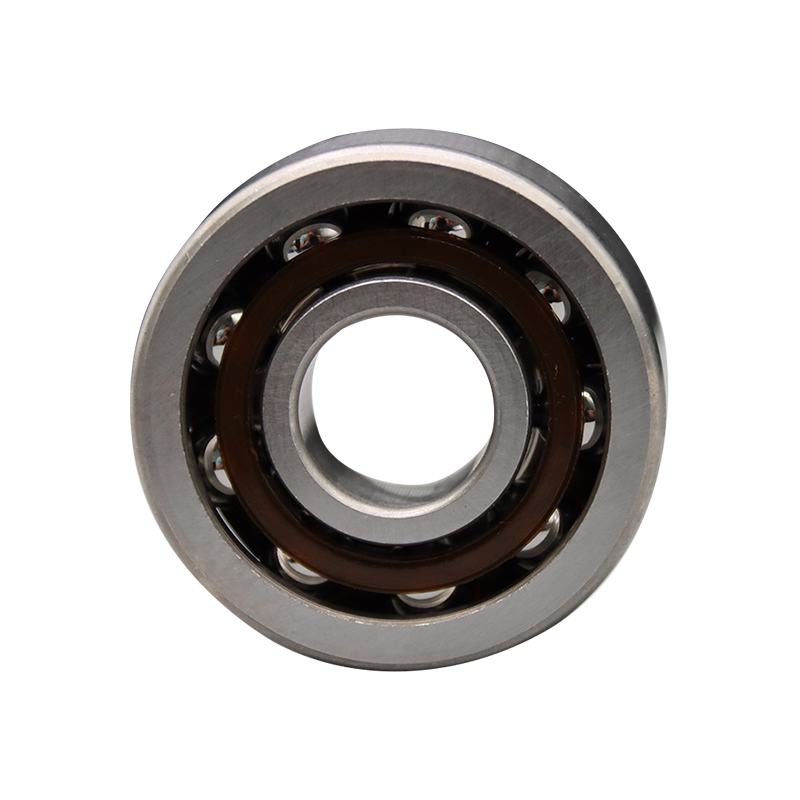 7900 Series Single Row Angular Contact Ball BearingsLightweight-cage bearings with 15 or 25 degree contact angles, built for high-speed and high-accuracy applications such as aerospace actuators and machine tools. They offer low friction and reliable load capacity.View Product →
The fastest route to a reliable high-speed spindle is a matched angular contact set with the right contact angle, a deliberate preload class, and lubrication confirmed against the DN target.
Start with the duty cycle: maximum speed, axial thrust at that speed, and acceptable temperature rise. These three inputs produce the contact angle, the arrangement, and the preload class - everything else follows.
Shanghai Yinin Bearing & Transmission Company works from those same variables when helping customers choose between the 7000, 7200, 7300, and 7900 series for new machine designs and retrofit programs.
The contact angle is the angle between the line joining the ball contact points on the raceways and a plane perpendicular to the bearing axis. It typically measures 15 deg, 25 deg, or 40 deg in single-row designs and controls the split between speed capability and axial load capacity.
Yes, it can carry purely radial load, but a single bearing only supports thrust in one direction. For alternating or reversing axial loads, mount two bearings in an opposed DB or DF arrangement so each direction is covered.
In precision angular contact ball bearings, DN above 400,000 to 500,000 usually requires oil-air or oil-jet lubrication. Below that range, a well-chosen grease with the correct base oil viscosity and cage compatibility will still deliver full bearing life.
Because each bearing supports axial load in one direction only. A matched pair set with the load lines facing each other (DB) or away (DF) creates a preloaded system that positions the shaft axially, resists overturning moments, and raises the assembly stiffness above what either bearing would provide alone.
Our provided products
Contact Us
Tel: +86-13916786238
Fax: +86-21-68551629
Email: [email protected]
Add: HuangXu Industrial Area, DanTu, ZhenJiang city, JiangSu Province, China
Industries


 English
 日本語
 Français
 Español