Industry Trends
2026-11-20
Content
A package-conveyor bearing at a beverage bottling plant failed three times in eight months. Each replacement was a deep groove ball bearing, and each failure left the same crescent-shaped wear band on one side of the raceway. A dial-gauge check of the housing revealed 1.4 degrees of angular misalignment caused by a canted mounting bracket. The plant switched to a self-aligning ball bearing, and the conveyor ran for fourteen months without a bearing failure. That sequence answers the practical question of when manufacturers should use self-aligning ball bearings in industrial equipment: when the machine geometry cannot keep the shaft aligned with the housing.
A self-aligning ball bearing is a double-row ball bearing whose outer ring raceway is ground on a sphere centered on the bearing center. The spherical raceway lets the inner ring, ball set, and cage pivot inside the outer ring, so the bearing corrects angular misalignment between shaft and housing by itself. In short, the bearing aligns itself instead of forcing the shaft into alignment.
Definition: A self-aligning ball bearing is a double-row radial ball bearing with a spherical outer-ring raceway that permits automatic compensation of angular shaft-to-housing misalignment, typically up to 2 to 3 degrees, without creating edge loading at the raceway.
This places the self-aligning ball bearing between two familiar alternatives. A deep groove ball bearing tolerates only about 0.1 to 0.3 degrees of misalignment before edge loading shortens fatigue life. A spherical roller bearing aligns just as well but is heavier, costlier, and limited to lower speeds. For fans, conveyors, and agricultural machines, the self-aligning ball bearing provides the alignment margin of a roller bearing at a price closer to a ball bearing.
Specify a self-aligning ball bearing when the measured or expected angular misalignment at the bearing seat exceeds about 0.3 degrees and the load is radial-dominant and light to moderate. The four checks below form a fast screening procedure for almost any industrial rotating assembly.
The strongest application fit is equipment that combines moderate speed, radial-dominant load, and a structure that flexes during operation. Industrial fans, belt conveyors, and agricultural cleaning machines fit that profile almost exactly, which is why they dominate the installed base of self-aligning ball bearings.
The pattern repeats across industries: a long shaft, a light sheet-metal or cast housing, and alignment that depends on assembly quality rather than precision machining. The following equipment types use the self-aligning ball bearing specifically for that reason.
| Application | Typical equipment | Why self-aligning works |
| Industrial fans | Centrifugal blowers, roof ventilators | Long shafts sag and welded bases distort; speeds and loads stay moderate |
| Conveyors | Belt conveyors, roller conveyors | Frame deflection under load misaligns the bearing blocks between pulleys |
| Agricultural machinery | Cleaning screens, separation fans, augers | Frame twist on uneven terrain; sealed versions keep out dust and chaff |
| Food and beverage lines | Washdown conveyors, mixing vessels | Housing wear after repeated washdown cycles; stainless variants resist corrosion |
| Textile machinery | Spinning frames, looms | Light loads with slight shaft whip at high rotational speeds |
In food and beverage processing, washdown spray, humidity, and caustic cleaning chemicals push plants toward stainless steel self-aligning ball bearings with dual-lip rubber seals. The bearing type solves the alignment problem; the material solves the corrosion problem. Both decisions have to be made together, or the bearing fails in a different but equally expensive way.
A quick comparison of angular misalignment capability explains why design engineers turn to this bearing class instead of a rigid deep groove unit.
Typical published values for standard catalog bearings. The self-aligning ball bearing delivers an order of magnitude more angular margin than a deep groove unit at a similar envelope.
Do not choose a self-aligning ball bearing for heavy radial shock, sustained axial thrust, or continuously high speed. The spherical raceway that delivers alignment also raises contact stresses, and the two-row ball arrangement gives the bearing a smaller load envelope than a deep groove unit of the same bore.
The two rows of balls carry load in curved grooves with a less favorable curvature ratio than a deep groove raceway. In comparable sizes, a self-aligning ball bearing typically has a dynamic radial load rating 30 to 40 percent lower than an equivalent-bore deep groove bearing, and a spherical roller bearing of the same bore often carries three to four times more radial load. Use these ratios as the first screen for any candidate application.
A vibrating screen that sees 5 g acceleration will hammer the cage of a self-aligning ball bearing to destruction in a matter of weeks. The bearing is a precision alignment device, not a shock absorber, and it should be selected where its load and speed ratings are actually comfortable.
Choose the narrow 1200 or 1300 series when axial space is tight and loads are light. Choose the wide 2200 or 2300 series when the same bore size must carry higher radial load or the shaft bends more. These four families cover nearly all standard industrial applications.
Shanghai Yinin Bearing & Transmission Company supplies the full self-aligning ball bearing range in chrome steel and stainless steel, with C0 or C3 clearance and open, shielded, or sealed finishes. For most industrial retrofits, the selection narrows to three families:
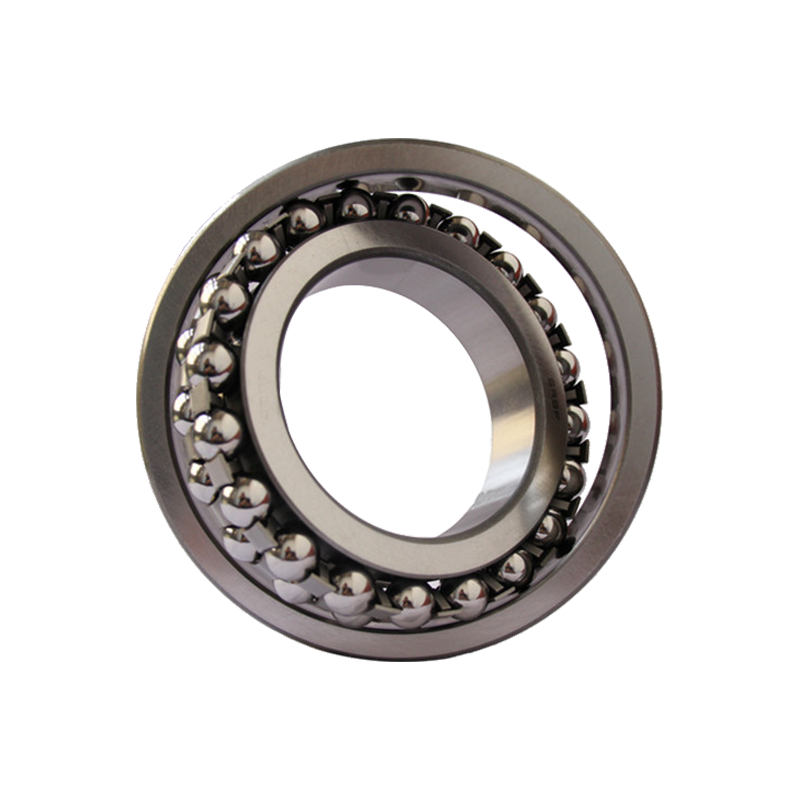 1200 Series Self-Aligning Ball Bearing for Industrial EquipmentThis series compensates for angular misalignment up to ±3°, reducing wear and maintenance. Its design suits motors, pumps, and fans where high speed and low noise are required.View Product →
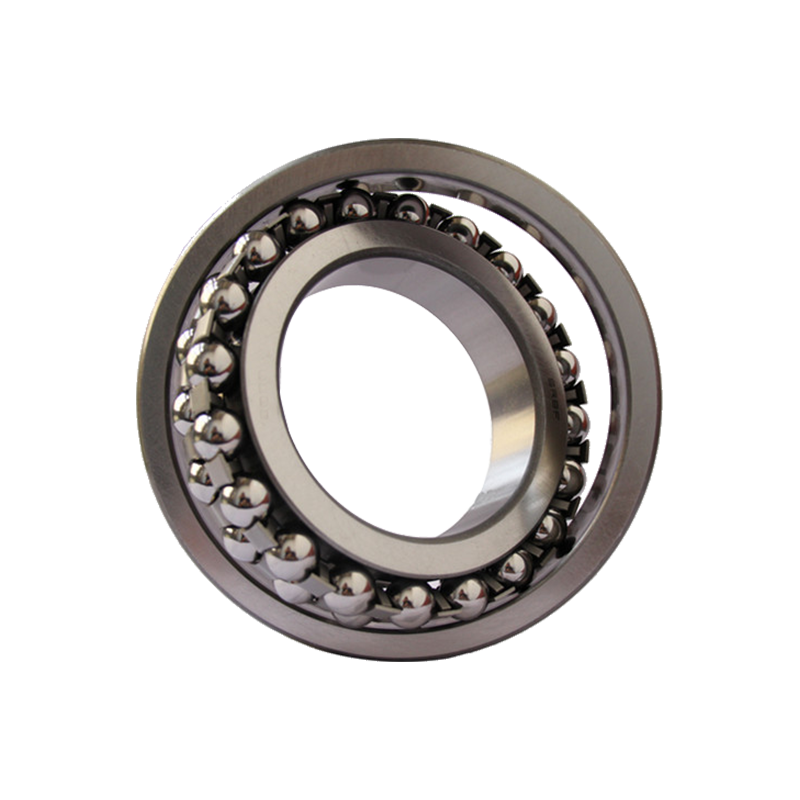 1300 Series Self-Aligning Ball Bearing with Enhanced Load CapacityBuilt for heavier radial loads and certain axial loads, this bearing offers automatic alignment and reduced vibration. It is ideal for transmissions, agricultural machinery, and automotive applications.View Product → 2200 Series Self-Aligning Ball Bearing for Reliable AutomationWith low friction and noise, this bearing simplifies installation and maintenance. It is often chosen for food processing, textile machinery, and automation equipment where dependable operation is critical.View Product →
These questions appear consistently when maintenance and design engineers compare self-aligning ball bearings with the rest of the bearing catalog.
A standard self-aligning ball bearing compensates for 2 to 3 degrees of total angular misalignment when unloaded. Under operating load, the practical limit is often lower because the loaded ball set restricts tilting, and sealed versions should be checked against the manufacturer data for the specific seal type. If the machine needs more than roughly 3 degrees of angular accommodation, a spherical plain bearing is the correct class.
Yes, but only modest amounts. The two rows of balls develop an internal contact angle that can carry axial force in both directions, yet the axial capacity is small compared with the radial rating. When the application has sustained axial thrust, a deep groove ball bearing of the same bore, or an angular contact bearing pair, is usually the safer selection.
Both types use a spherical outer raceway to handle misalignment, but a spherical roller bearing uses barrel-shaped rollers, which gives it roughly three to four times the radial load capacity of a self-aligning ball bearing at the same bore size. The spherical roller bearing is also heavier, slower, and more expensive. Use the spherical roller type for heavy radial loads; use the self-aligning ball type for standard industrial loads with misalignment.
No. The alignment function happens inside the bearing, so the shaft and housing fits follow the same ISO tolerance classes as other radial ball bearings, typically j6 or k5 for the shaft and H7 or H8 for the housing bore depending on which ring rotates. Do not try to correct misalignment by increasing shaft clearance; internal clearance and fits are independent decisions.
Our provided products
Contact Us
Tel: +86-13916786238
Fax: +86-21-68551629
Email: [email protected]
Add: HuangXu Industrial Area, DanTu, ZhenJiang city, JiangSu Province, China
Industries


 English
 日本語
 Français
 Español