Industry Trends
2026-10-07
Content
A maintenance engineer orders 500 pieces of a 6204-2RS deep groove ball bearing from three different suppliers. The prices vary by more than 30 percent, yet the part numbers on the boxes are identical. Six months later, only one batch is still running quietly in the motor assemblies. The difference was not luck, and not the brand printed on the box. It was a set of decisions made before the purchase order was issued.
Buying deep groove ball bearings wholesale is a technical procurement exercise, not a price negotiation. One failed batch costs far more than any price gap between suppliers: rework, downtime, warranty claims, and damaged customer relationships. The conclusion is straightforward: define the operating conditions first, then match series, tolerance, clearance, sealing, material, and packaging, and only then evaluate suppliers. If a supplier quotes from nothing but a part number and a quantity, treat that as a warning sign.
The duty cycle of the machine determines which bearing series, internal clearance, and seal type you actually need. If you request quotes without defining load, speed, temperature, and contamination levels, you will receive the cheapest bearing that fits the shaft — and it may be the most expensive one to run.
Deep groove ball bearings handle combined radial and moderate axial loads. Pure axial loads normally call for a thrust bearing. Speed matters because the limiting speed depends on the cage design, seal type, grease properties, and internal clearance. Temperature matters because it changes grease behaviour and the effective internal clearance. Contamination matters because it decides whether you need shields, contact seals, or a different material altogether.
A small high-speed fan and a heavy gearbox can use the same shaft diameter and still need different bearings. When the duty is moderate, as in a pump or a general-purpose motor, the 6200-series deep groove ball bearings are the usual first choice because they balance load capacity, speed, and availability. When the load gets heavier, review the larger cross-section offered by the next series.
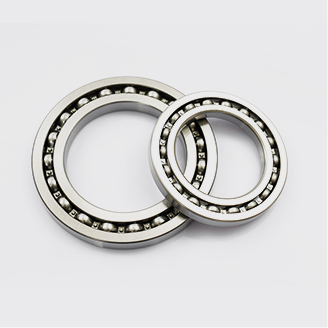
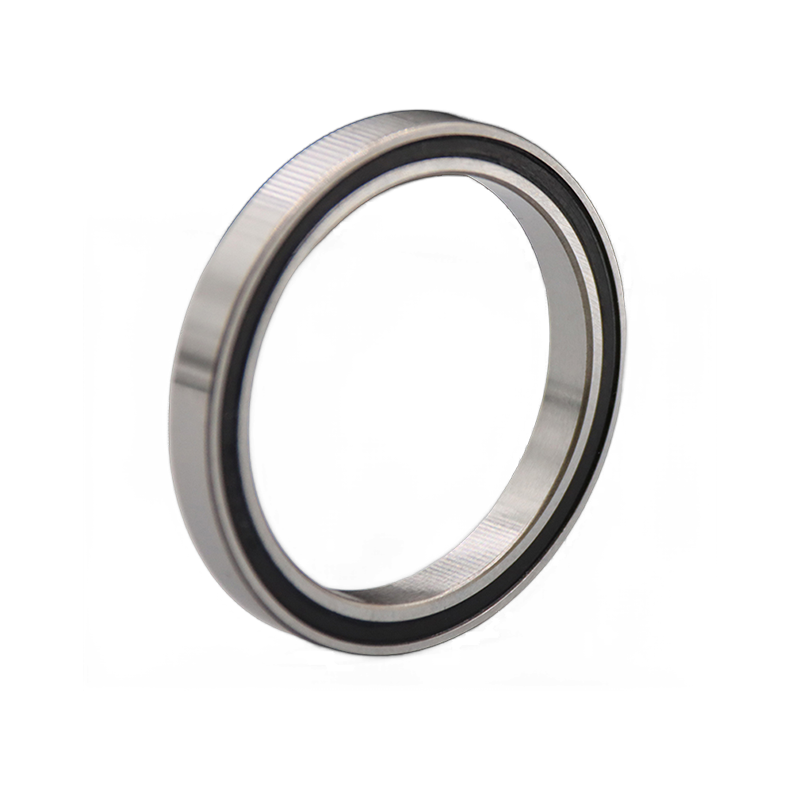 Custom 6200 Series Deep Groove Ball Bearing Manufacturers, FactoryShanghai Yinin Bearing & Transmission Company Is China 6200 Series Deep Groove Ball Bearing Manufacturers and custom 6200 Series Deep G...View Product →
Deep groove ball bearings are dimensionally standardized under ISO 15, so a 6204 and a 6304 share the same bore and outer diameter but differ in width and load capacity. The series number encodes the load-carrying geometry: 6000 is compact and light, 6200 is the general-purpose workhorse, 6300 adds more rolling elements and a wider cross-section for the same bore size, while the 6800 and 6900 families serve space-constrained units.
| Series | Typical bore range | Relative radial load | Typical applications |
|---|---|---|---|
| 6000 | 10–47 mm | Light | Small motors, instruments, household appliances |
| 6200 | 10–60 mm | Moderate | Pumps, fans, general industrial machinery |
| 6300 | 10–130 mm | Heavy | Gearboxes, conveyors, larger electric motors |
Before ordering, verify the full dimensions against the housing and shaft drawings. A common mistake is to treat a similar series with the same bore as a drop-in replacement. With the same bore, a 62xx and a 63xx differ in outer diameter and width; a 68xx or 69xx differs even more. One wrong width means a modified housing, a spacer, or a rejected batch.
For heavier radial loads at moderate speeds, the 6300-series deep groove ball bearing provides more static and dynamic load capacity than a 6200 with the same bore. This matters in gearboxes and conveyor drives, where premature fatigue is often traced back to an undersized cross-section. The same logic applies in automotive bearing applications, where envelope constraints and duty cycles vary from accessory drives to wheel-end assemblies.
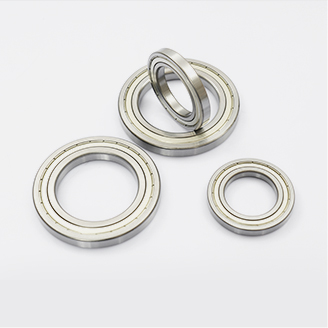
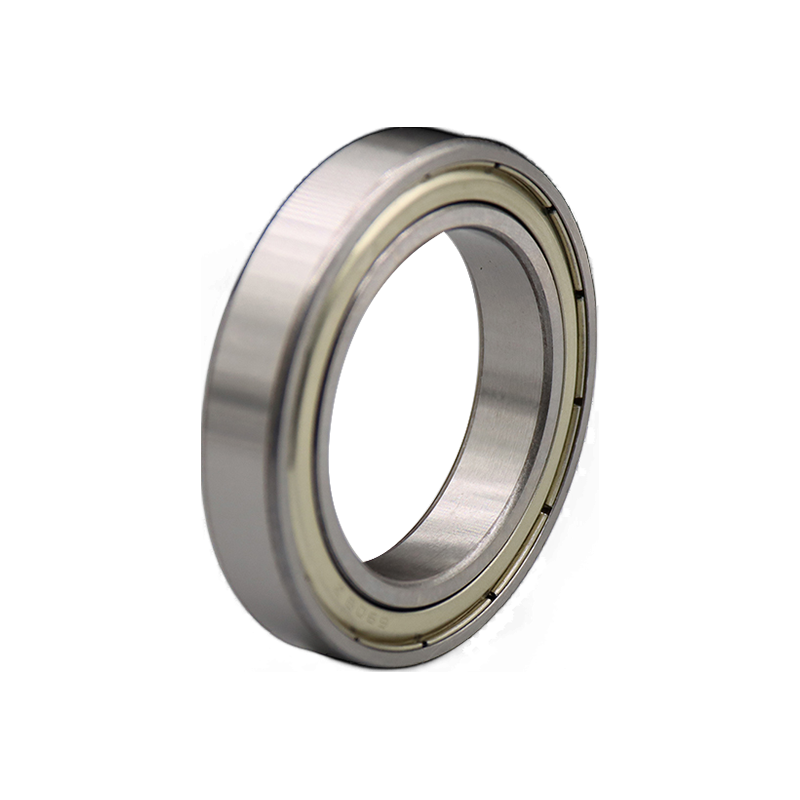 Custom 6300 Series Deep Groove Ball Bearing Manufacturers, FactoryShanghai Yinin Bearing & Transmission Company Is China 6300 Series Deep Groove Ball Bearing Manufacturers and custom 6300 Series Deep G...View Product →
The bearing's internal clearance must be matched to the fit and the operating temperature, and the tolerance class must match the speed and precision of the machine. Getting these wrong produces noise, vibration, heat, and early spalling, even when the bearing itself is brand new and the dimensions are correct.
Tolerance classes cover the P0-to-P5 range. P0, the normal class, is adequate for most industrial equipment. P6 and P5 reduce runout for higher-speed spindles, instruments, and precision electric motors. A CNC spindle needs a different precision class than a conveyor trolley.
Internal clearance, marked C2, CN, C3, or C4, is the radial play inside the bearing before mounting. The common mistake is to assume that CN is always correct. When a bearing is pressed onto a steel shaft with an interference fit, the inner ring expands and takes up part of that clearance. If the shaft runs hotter than the housing, clearance closes further. In those situations, C3 avoids preload, temperature rise, and premature failure.
A typical electric motor uses a j6 or k6 shaft fit and an H7 housing fit, and under those conditions a CN-clearance bearing can become zero-clearance or slightly preloaded once installed and warmed up. That is why many motor manufacturers specify C3 as standard. The lesson for wholesale buyers: if your blueprint does not mention clearance, ask the engineer who wrote the blueprint, and do not let the supplier decide for you.
The seal and grease decide the maintenance interval. A shielded bearing can outlast a sealed bearing in a clean, high-speed application, while a sealed bearing survives a dusty workshop floor that would destroy an open or shielded unit quickly.
Grease selection is equally important. Operating temperature, NLGI grade, base oil viscosity, and additives all change the behaviour of the bearing over its life. Food-grade H1 grease is mandatory in food processing equipment, where a conventional grease can contaminate the product.
For light, high-speed units such as small motors and household appliances, the 6000-series deep groove ball bearings are often specified with metal shields because low torque matters more than contamination resistance. In food and beverage bearing requirements, the decision usually moves to stainless steel and rubber seals with H1 grease, even at a higher cost per piece, because a production line stop costs far more than a bearing.
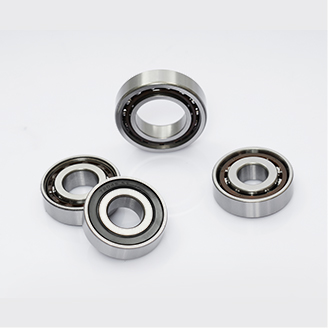
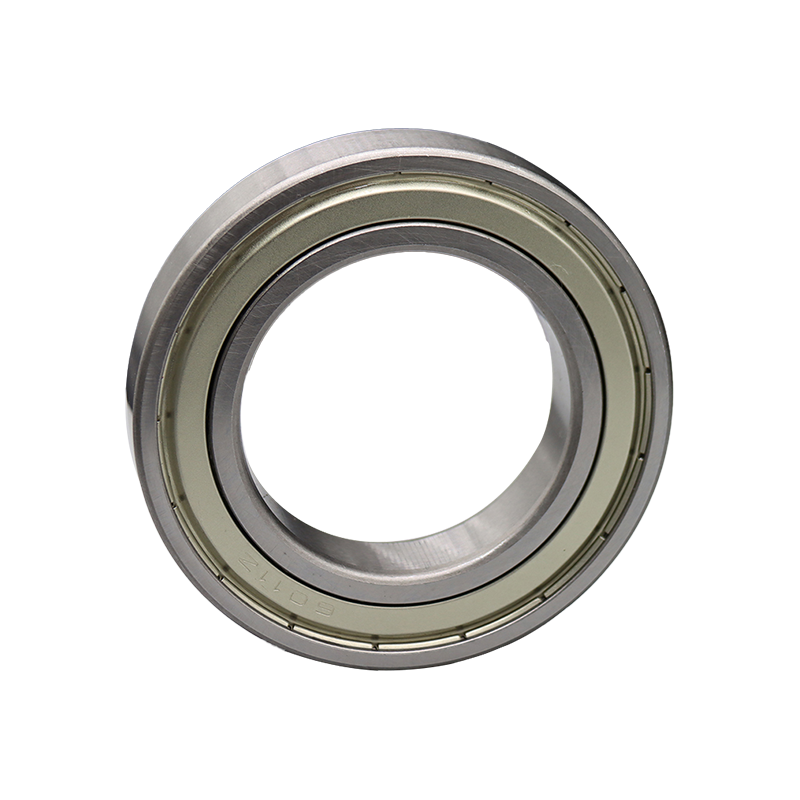 Custom 6000 Series Deep Groove Ball Bearing Manufacturers, FactoryShanghai Yinin Bearing & Transmission Company Is China 6000 Series Deep Groove Ball Bearing Manufacturers and custom 6000 Series Deep G...View Product →
Chrome steel, typically GCr15 or SAE 52100, covers the majority of industrial applications. It offers high hardness, good fatigue life, and the lowest price. But where moisture, chemicals, or frequent washdown are present, stainless steel is not an upgrade; it is the difference between a three-month life and a three-year life.
Two stainless grades dominate wholesale deep groove ball bearing orders. 440C provides high hardness and good corrosion resistance for washdown areas and mildly corrosive atmospheres. 316 offers better corrosion resistance but lower hardness, so it is reserved for chemically aggressive settings where loads stay modest. If the application combines high load and high corrosion, discuss the trade-off with the supplier instead of assuming that stainless means the same bearing, just rustproof.
Food processing lines, medical device maintenance, and marine-adjacent equipment are the typical cases. In those environments, a chrome steel bearing with a damaged seal corrodes from the inside out, and the corrosion debris then acts as an abrasive. The material decision must be made at the specification stage, because changing material after a failed batch means re-qualifying the whole order.
One of the biggest hidden risks in wholesale purchasing is not the bearing that fails on a test bench but the inconsistency between batches. When you buy 2,000 pieces, the 2,000th piece has to match the first one, or your assembly line will discover the difference at the worst possible moment.
A supplier that ships from old mixed stock because the factory cannot deliver on time is a common source of bad batches. The symptoms are inconsistent noise levels, varying grease color, or different stamping patterns on the shields. These visual clues are worth checking on the first batch and on every batch after a change in the production schedule.
Supplier qualification is where wholesale buyers save the most money. A sample order tells you about dimensions and noise; it does not tell you about batch consistency, delivery reliability, or how the supplier will handle a non-conformance six months later.
Ask these questions during qualification:
A trading and export company such as Shanghai Yinin Bearing & Transmission Company sits in a practical position for many wholesale buyers. Because it consolidates a structured product range across series, it can keep deep groove ball bearing orders consistent while also covering related bearing types and automotive components in the same program. That simplifies qualification, inspection, and logistics.
Wholesale deep groove ball bearings should be bought by specification, not by price per piece. Define the operating conditions, select the series and dimensions from the real installation, match tolerance, clearance, and seal type to the duty, choose the material based on the environment, and confirm that packaging and batch control protect the product through delivery. Then evaluate the supplier on data, change management, and consistency, not on the promise of a low unit price.
The best wholesale program is the one that makes every thousand bearings behave the same way as the sample. For day-to-day care on the machinery side, the deep groove ball bearing maintenance guide covers lubrication, inspection intervals, and common signs of wear that point back to specification errors. Combine the two, and the cost per running hour stays where it belongs.
Our provided products
Contact Us
Tel: +86-13916786238
Fax: +86-21-68551629
Email: [email protected]
Add: HuangXu Industrial Area, DanTu, ZhenJiang city, JiangSu Province, China
Industries


 English
 日本語
日本語
 Français
 Español