Industry Trends
2026-11-06
Content
A hub unit that measures inside tolerance on the bench can still trigger an ABS fault within the first few hundred kilometres if the encoder ring is fitted facing the wrong way or the sensor gap falls outside the window the control unit expects. On a front-drive car the wheel hub bearing carries the vehicle mass, fixes the position of the brake disc and the wheel, and on designs with an integrated encoder also generates the wheel speed signal. Generation, seal architecture, encoder type and mounting method all have to line up before the part is pressed or bolted home.
Wheel hub bearings are built in four generations, and the generation decides how the unit is located in the knuckle, where axial clearance is set, and which sealing and encoder options the design allows.
Definition: a wheel hub bearing is a pre-assembled, pre-greased and pre-set rolling bearing that locates the wheel and brake disc on the suspension, carries radial and axial wheel loads, and from the second generation onward integrates the mounting flange and, in most designs, the wheel speed encoder.
First generation units are a matched pair of single-row angular contact bearings, or a double-row bearing with separate outer rings, pressed into the knuckle. The hub flange is a separate part, axial clearance is set during assembly, and the seal sits outside the bearing. Servicing means pressing, not unbolting.
Second generation units weld or form the flange onto the outer ring. The brake disc and wheel bolt directly to the bearing, but the unit is still an interference fit in the knuckle, so bore tolerance and press tooling still decide whether the assembly runs true.
Third generation units add a flange on the inner ring as well and become a bolt-on cartridge. Clearance is set at the factory, the unit is sealed for life, the encoder is integrated, and the complete assembly is replaced with new mounting bolts torqued to the vehicle manufacturer's figure.
Fourth generation units spline the inner ring onto the constant velocity joint stub, so the hub also transmits drive torque on driven axles.
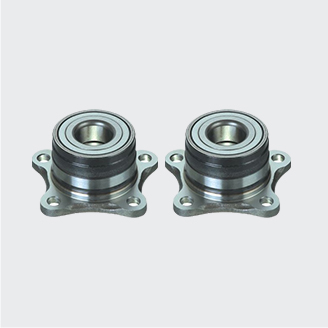
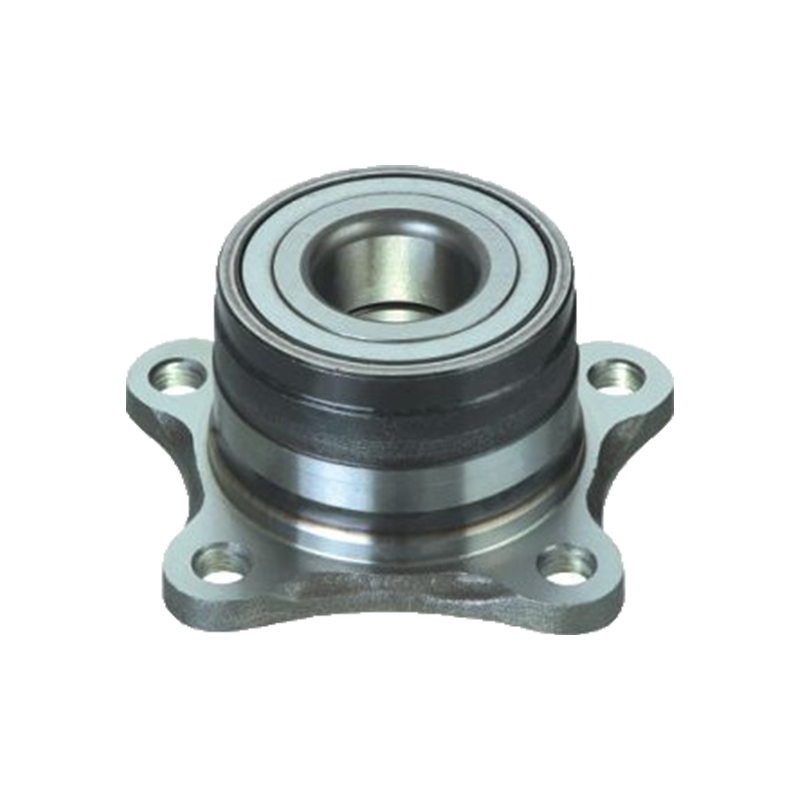 GEN3 Integrated-Flange Hub Unit Automotive BearingIntegrated hub-and-bearing unit with factory pre-greasing, sealing and ABS encoder options for passenger-car axle assemblies.View Product →
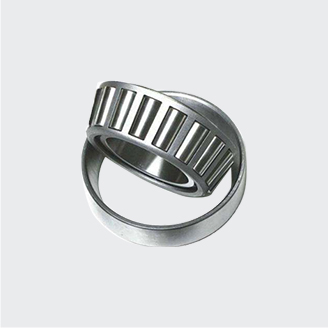
Double-row angular contact ball units cover passenger-car axle loads, while tapered roller units are specified where radial load is higher and the hub must also absorb offset forces.
Ball hub units typically run contact angles between 25 and 35 degrees, which keeps friction and noise low at the cost of axial capacity. Tapered roller units use line contact, carry more radial load in the same envelope, and appear on light commercial vehicles, SUVs, trailers and agricultural machinery axle assemblies. They are also less forgiving: end play outside the manufacturer's band produces disc wobble, while excessive preload raises running temperature and shortens grease life.
Rating life follows the ISO 281 basis, L10 = (C/P)^p in millions of revolutions at 90 percent reliability, with p = 3 for ball bearings and p = 10/3 for roller bearings. Illustrative calculation: with a dynamic rating of 30 kN and an equivalent load of 6 kN, a ball unit returns (30/6)^3 = 125 million revolutions, while the same figures on a tapered roller unit return roughly 214 million.
In a sealed, pre-set hub unit the grease and the seal decide service life. The raceway steel rarely gets the chance to fatigue first.
Seal architecture separates a hub that lasts the life of the vehicle from one that fails after two winters, and the encoder seal is the component most often installed the wrong way round.
Contact lip seals are the baseline: a bonded elastomer lip running on a ground surface, usually backed by a secondary dust lip. Cassette seals add a metal slinger and several lips in one pressed unit, which improves exclusion of water and grit at the cost of higher drag. Labyrinth seals are non-contact and run cool but offer limited protection against submersion or steam cleaning. Encoder seals combine the sealing function with a magnetised rubber ring that an active ABS sensor reads.
| Seal type | Contact mode | Typical material | Strength | Limitation |
| Lip seal | Single contact lip plus dust lip | NBR | Low cost, low drag | Water ingress under pressure |
| Cassette seal | Multiple lips with integrated slinger | NBR or FKM | Strong exclusion of water and grit | Higher drag and higher cost |
| Labyrinth seal | Non-contact | Steel or polymer | Very low drag at high speed | Weak against submersion |
| Encoder seal | Contact lip plus magnetised ring | NBR with ferrite filler | Sealing and speed signal in one part | Direction-sensitive fitting |
Elastomer choice sets the temperature window. Nitrile (NBR) is rated for continuous operation from about minus 40 to plus 100 degrees Celsius, fluoroelastomer (FKM) from about minus 20 to plus 200 degrees Celsius, which buys high-temperature headroom at the price of low-temperature flexibility. Those are typical datasheet ratings and move with compound and duty cycle.
 DAC-Series Wheel Bearings for Passenger VehiclesDAC-series wheel bearings with listed dimensions and vehicle applications; seal and encoder orientation guidance helps avoid fitment errors.View Product →
Fit the encoder side toward the sensor, never toward the bearing interior. A reversed seal produces a clean-looking installation and no usable wheel speed signal. Keep pressure-washer jets off the seal lip and off the encoder face.
Six checks decide whether a hub unit is compatible: bore and flange geometry, encoder signal type, seal and grease specification, mounting method and bolt torque, brake disc interface runout, and the condition of the mating knuckle and joint.
Requirements are platform-specific, and the same 42 mm bore can appear in three different configurations. Application-based catalogues, such as the automotive bearing range, make that cross-check faster than a pure dimension search.
A correct hub installation follows five steps, and none of them involves a hammer.
A wheel bearing is the rolling element set alone. A hub unit bearing adds the flange, the factory-set clearance, the life-time grease fill and, from the second generation onward, the encoder. A first generation wheel bearing can be replaced on its own, while a third generation unit is replaced as a complete bolted assembly.
Yes, and that is the problem. The flange and bore fit perfectly, but a ring with the wrong pole count or facing direction produces no usable signal and the ABS lamp returns within the first drive cycle. Match the encoder to the sensor type before ordering.
No. Sealed-for-life units are filled once at assembly, and opening them destroys the seal. Only serviceable first generation bearings are re-greased, at the interval the vehicle manufacturer specifies, using a grease with a compatible thickener and NLGI grade.
A cassette seal with multiple lips and a slinger resists water jets better than a single lip seal, but no lip seal survives a jet aimed directly at the lip. Keep the nozzle off the seal gap and off the encoder face.
Our provided products
Contact Us
Tel: +86-13916786238
Fax: +86-21-68551629
Email: [email protected]
Add: HuangXu Industrial Area, DanTu, ZhenJiang city, JiangSu Province, China
Industries


 English
 日本語
 Français
 Español