Industry Trends
2026-10-23
Content
A gearbox on a continuous caster failed after 14 months of service. Vibration analysis flagged edge loading on the roller set, and the housing bore measured 0.4 mm out of round after the previous bearing replacement. The engineer choosing a replacement had two credible options: a tapered roller bearing or a spherical roller bearing. The correct choice depends on load direction, shaft deflection and how much misalignment the mounting can tolerate, not on habit or price alone.
Tapered roller bearings carry combined radial and axial loads through converging load lines, while spherical roller bearings manage heavy radial loads with built-in self-alignment.
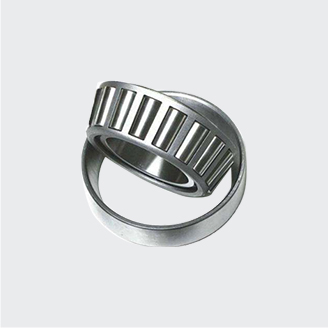
Tapered roller bearings use conical rollers guided between an angled inner raceway and a matching outer ring. The load lines converge at a single point on the bearing axis, which is why a single row absorbs thrust in one direction only. Industrial installations therefore mount tapered bearings in pairs, arranged back-to-back or face-to-face, so axial loads are balanced in both directions. Contact angles typically fall between 10 and 30 degrees, with steeper angles providing higher axial capacity.
 Wholesale Tapered Roller Bearing for Paired Axial Load ApplicationsThis tapered roller bearing supports single-direction thrust and is typically mounted in pairs for balanced axial loads. Review it here to understand its contact angle options and role in industrial gearboxes and wheel ends.View Product →
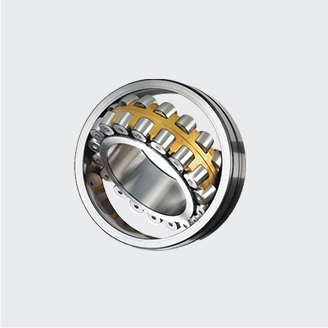
Spherical roller bearings use barrel-shaped rollers running between a spherically ground outer raceway and a double-lip inner raceway. The spherical outer ring lets the inner ring and roller assembly pivot inside the housing, compensating for shaft flex and housing bore distortion. Most series tolerate 1.5 to 2 degrees of angular misalignment without a reduction in rating life. The trade-off is lower axial capacity compared with a matched tapered pair of the same bore size.
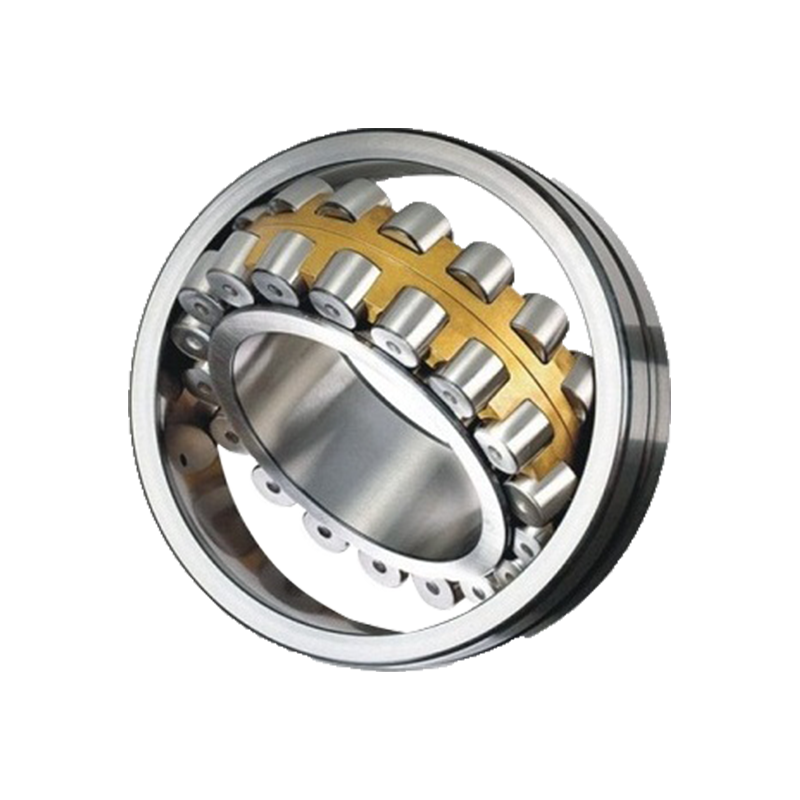 Wholesale Spherical Roller Bearing for Misalignment CompensationThis spherical roller bearing self-aligns to accommodate shaft flex and housing distortion with 1.5 to 2 degrees of misalignment tolerance. Its design suits heavy radial loads, though axial capacity is lower than tapered pairs.View Product →
At Shanghai Yinin Bearing & Transmission Company, the selection process starts with catalogue structure: tapered series such as 30200, 32200 and 32300 cover gearboxes and wheel ends, while spherical series such as 22200 and 22300 dominate heavy radial-load machinery.
Spherical roller bearings deliver more radial load capacity per envelope size; tapered roller bearings sustain higher speeds and produce stiffer axial systems.
At the same bore size, a spherical roller bearing typically supports 20 to 30 percent more radial load than a tapered roller bearing of the same width, because the barrel-shaped rollers make line contact over a longer effective length. Tapered bearings generate less sliding heat at the rib and therefore hold a higher limiting speed. In a gearbox comparison, a 32032 tapered set will run faster, while a 22232 spherical unit will accept a heavier continuous radial load while the shaft deflects.
| Criteria | Tapered roller bearings | Spherical roller bearings |
| Rolling element | Conical rollers | Barrel-shaped rollers |
| Radial load capacity | High | Very high, 20 to 30 percent higher at equal bore size |
| Axial load capacity | High when paired; single row unidirectional | Moderate, 15 to 20 percent of radial load |
| Speed capability | Higher limiting speed | Moderate, size-dependent de-rating |
| Misalignment tolerance | 0 to 0.3 degrees | 1.5 to 2 degrees |
| System stiffness | Very high, radial and axial | Good radial, lower axial |
| Mounting practice | Matched pairs, shims or preload | Single unit, standard housing fit |
Spherical roller bearings forgive shaft deflection and housing bore misalignment; tapered roller bearings require rigid, precisely aligned housings and careful setting.
Vibrating screens, conveyor drives and fan shafts all flex under load. A spherical roller bearing absorbs a 1-degree shaft slope and keeps the load zone centered on the rollers. A tapered roller bearing subjected to the same slope develops edge loading on the outer raceway, which raises contact stress and shortens fatigue life. If the housing bore cannot be corrected, the spherical design is the safer engineering choice.
Use tapered roller bearings for gear drives, wheels, pinions and spindles; use spherical roller bearings for heavy radial loads, shock loads and misaligning shafts.
The decision logic follows the machine. Industrial gearboxes, crane wheels, automotive wheel hubs and machine tool spindles run on tapered bearings because the paired mounting delivers axial rigidity and precise preload. Vibrating screens, belt conveyors, fans, mine hoists and pulverizers run on spherical bearings because the frame flexes and the load is predominantly radial.
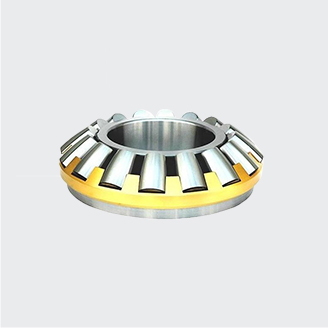
22200 Series Spherical Roller Bearing for Heavy-Duty MachineryPart of the 22200 series, this spherical roller bearing handles high radial and moderate axial loads while self-aligning. Its chrome steel construction suits vibrating screens, conveyors, and other equipment with structural misalignment.View Product →
Applications best served by tapered roller bearings:
Applications best served by spherical roller bearings:
The same selection logic appears across our industry pages, from construction equipment to food processing lines. For a deeper review of clearance and housing fits on the spherical side, see our guide on selecting spherical roller bearings.
Tapered roller bearings are usually more economical and easier to source in small and mid sizes; spherical roller bearings have a higher first cost but reduce maintenance in misalignment-prone machinery.
Small tapered sets such as the 30208 or 32010 are commodity items with short lead times and straightforward replacement practice. Large spherical units in the 22300 and 24000 series carry a higher purchase price, but in vibrating screen service they frequently extend the rebuild interval from 8 to 10 months to 3 or 4 years. When total cost of ownership is calculated over a five-year window, the spherical bearing often wins in equipment where alignment cannot be guaranteed.
Only if the housing is re-machined to guarantee bore alignment and the axial load is recalculated for a paired tapered setup. In a misaligning housing, the tapered bearing will edge-load and fail faster than the spherical bearing it replaced.
Spherical roller bearings manage radial shock loads better because of their longer roller contact and self-aligning geometry. Tapered roller bearings handle shock better when the dominant shock is axial, as in bevel gear drives and crane slew mechanisms.
In practice, less than 0.3 degrees. Beyond that, edge loading appears on the outer raceway and rating life drops quickly. If the shaft deflection or housing distortion exceeds this, a spherical roller bearing is the safer selection.
No. A single spherical roller bearing positions the shaft radially and self-aligns within the housing. It accepts moderate axial load, although not as much as a matched tapered pair of the same bore size.
Our provided products
Contact Us
Tel: +86-13916786238
Fax: +86-21-68551629
Email: [email protected]
Add: HuangXu Industrial Area, DanTu, ZhenJiang city, JiangSu Province, China
Industries


 English
 日本語
 Français
 Español