Industry Trends
2026-10-30
Content
A maintenance supervisor once budgeted a full shift to change a failed bearing on a bucket elevator head shaft: the direct-mounted arrangement needed housing work, a puller, and dial-indicator alignment. A pillow block removes nearly all of that. The housing arrives machined, the insert is pre-greased and sealed, and the swap finishes in well under an hour with hand tools. That is why pillow block units now carry most fan, conveyor, and processing-line applications.
A pillow block bearing is a complete, bolt-on unit: an insert bearing seated in a pre-machined housing, with seals, a locking collar, and the mounting base cast into the same assembly.
The spherical outer diameter is the design key. UC200 and UK200 series inserts rock slightly in the housing bore, absorbing frame deflection and bolt-hole error before it reaches the rolling elements; most inserts accept about 2 degrees of static misalignment without losing rated life.
Housing geometry only changes the mounting interface: UCP for two-bolt horizontal frames, UCF flanges for vertical plates, and UCT slides for conveyor take-up frames.
Installing a pillow block takes five steps - position, bolt, lock, rotate, lubricate - with no dial indicator and no press fit.
| Work step | Pillow block unit | Direct-mounted arrangement |
| Housing preparation | None; housing cast and bored at the factory | Bore or fabricate a seat, then scrape or shim |
| Alignment | Spherical OD self-aligns to the shaft | Dial indicator and corrective shimming |
| Lubrication | Pre-greased and sealed at shipment | Manual grease fill and bleed on site |
| Change-out time | 30-45 minutes with hand tools | 4-6 hours with pullers and heaters |
| Skill level | One trained technician | Fitter plus assistant and machine shop support |
For general-duty fans, line shafts, and agricultural equipment, the UCP series with its wide two-bolt base is the standard first choice: it locates on drilled holes in a single plane.
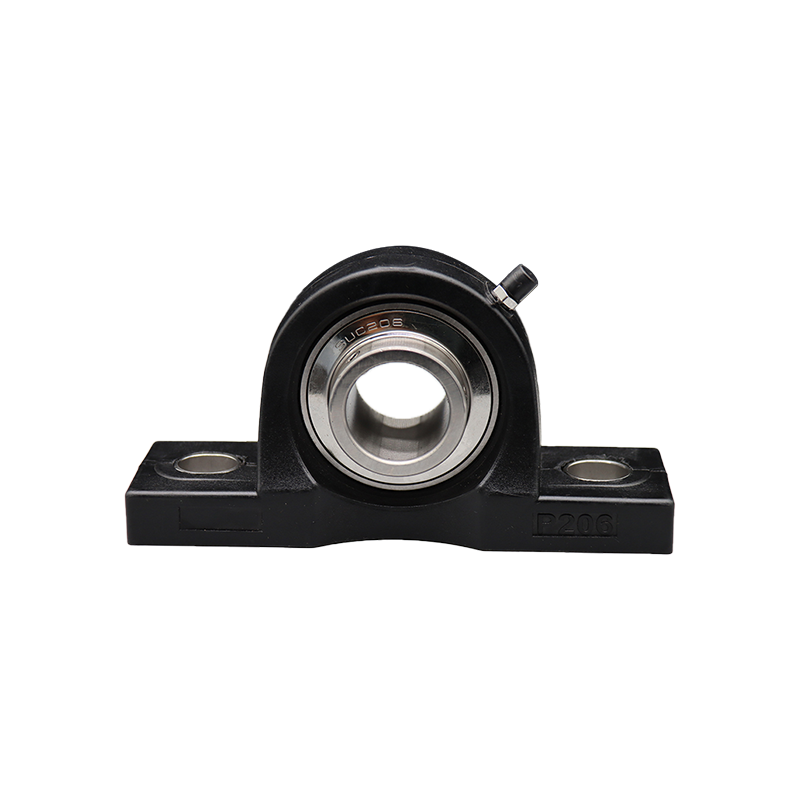 UCP Series Pillow Block Bearing Units for General-Duty EquipmentThe UCP pillow block features a wide two-bolt base for easy mounting on drilled holes. Its cast iron or aluminum housing and removable ball bearing simplify routine maintenance, making it a practical choice for fans, conveyors, and agricultural machinery.View Product →
Routine pillow block maintenance is a scheduled job - grease, inspect, verify lock tightness - with no need to break the machine train.
The grease fitting sits outward for easy gun access, and field practice is simple: relubricate on a fixed schedule, then check seals and locking hardware in the same pass.
Stop greasing early. One or two shots from the gun per interval keep the cavity at the right level; forcing in more grease pushes the seals open and turns a sealed bearing into a dirt pump.
On belt conveyors, the take-up pillow block (UCT series) adds another advantage: belt tension is restored by moving the bearing along the frame with a threaded rod, without unbolting the housing from the deck.
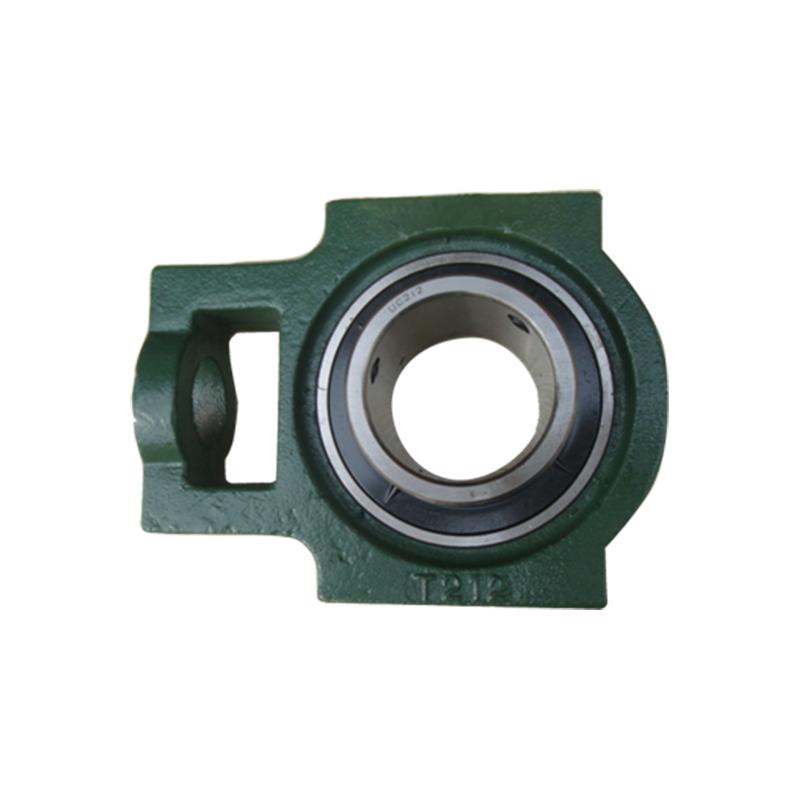 UCT Series Take-Up Pillow Block Bearings for Belt TensioningEngineered with a sliding slot housing and spherical insert bearing, this take-up unit allows belt tension adjustment via a threaded rod without unbolting. Ideal for conveyors and power transmission systems requiring shaft alignment and center distance changes.View Product →
Choose a pillow block on five inputs: load, shaft diameter, mounting geometry, environment, and whether the shaft must move in service.
Insert choice follows the shaft. UC200 inserts with set screws suit standard commercial shafts; UK200 adapter-sleeve inserts handle longer shafts with thermal movement. In washdown plants, choose stainless inserts with food-grade grease; in dusty plants, a 2RS contact seal blocks particles better than an open shield.
The direct-mounted arrangement takes six times longer before the shaft can rotate again.
For vertical plates and confined end positions, the UCF flange bolts directly to the machine frame and removes the pedestal fabrication step.
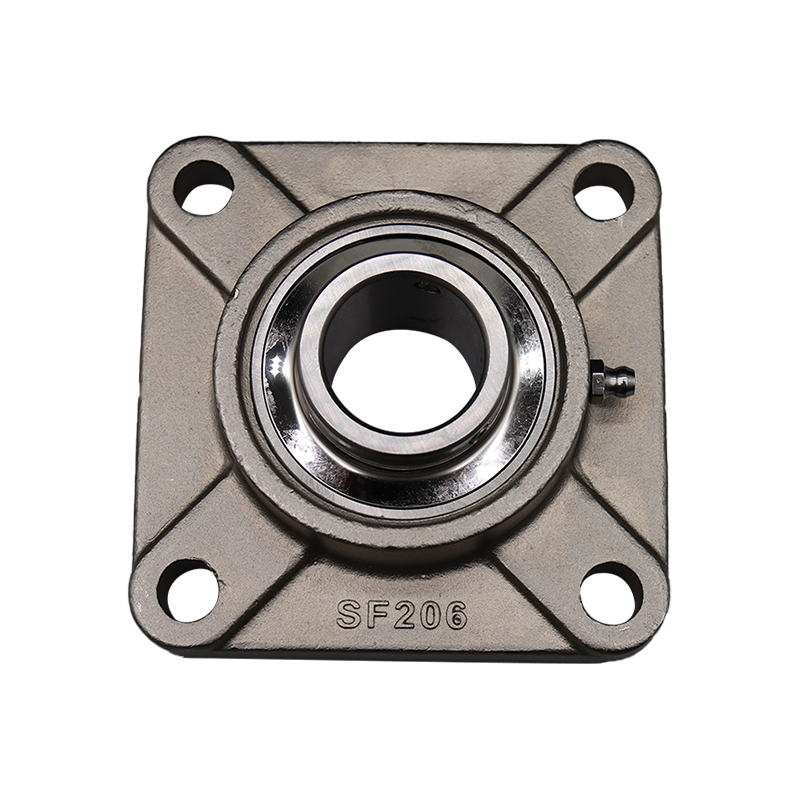 UCF Series Flange-Mounted Bearing Units for Confined PositionsThe UCF flange bolts directly to machine frames, removing the need for a pedestal. Its cast iron housing, self-aligning ball bearing, and sealed design offer durability and reduced vibration, suitable for vertical plates and space-limited industrial applications.View Product →
A pillow block is only as reliable as the bearing inside it, so the practical choice is a supplier that controls insert, seal, and housing as one matched system.
Shanghai Yinin Bearing & Transmission Company supplies the complete pillow block family - UCP, UCF, UCFC, UCFL, and UCT - plus the UC200, UC300, and UK200 inserts that fit them, and applies them across major industrial segments, from food and beverage processing lines to automotive production and construction machinery.
One source simplifies three things: specification, because every unit shares one locking system; spare inventory, because the same insert fits several housing styles; and training, because one procedure covers every unit in the plant. The company's ongoing work in the pillow block bearing market keeps seal and locking collar designs current.
The questions below are the ones maintenance teams ask most often when they move to pillow block units.
Yes, within the range of its spherical outer diameter. Insert bearings typically absorb about 2 degrees of static angular misalignment, which covers frame deflection and ordinary bolt-hole error, but not parallel offset, so the shaft line still must be reasonably straight.
For normal speed and temperature, plan on every 3-6 months or every 1,000-2,000 running hours. Washdown or dusty duty requires shorter intervals. Over-lubrication fails more bearings than under-lubrication.
U stands for the UC-series insert bearing; the second letter identifies the housing - P for pillow block base, F for flange, and T for take-up slide. All share the same insert, so spares stay common across the plant.
Yes. Loosen the set screws and the insert slides off the shaft while the housing stays bolted to the frame. Check the base for fretting, clean the bore, and re-grease before fitting the replacement insert.
Our provided products
Contact Us
Tel: +86-13916786238
Fax: +86-21-68551629
Email: [email protected]
Add: HuangXu Industrial Area, DanTu, ZhenJiang city, JiangSu Province, China
Industries


 English
 日本語
 Français
 Español